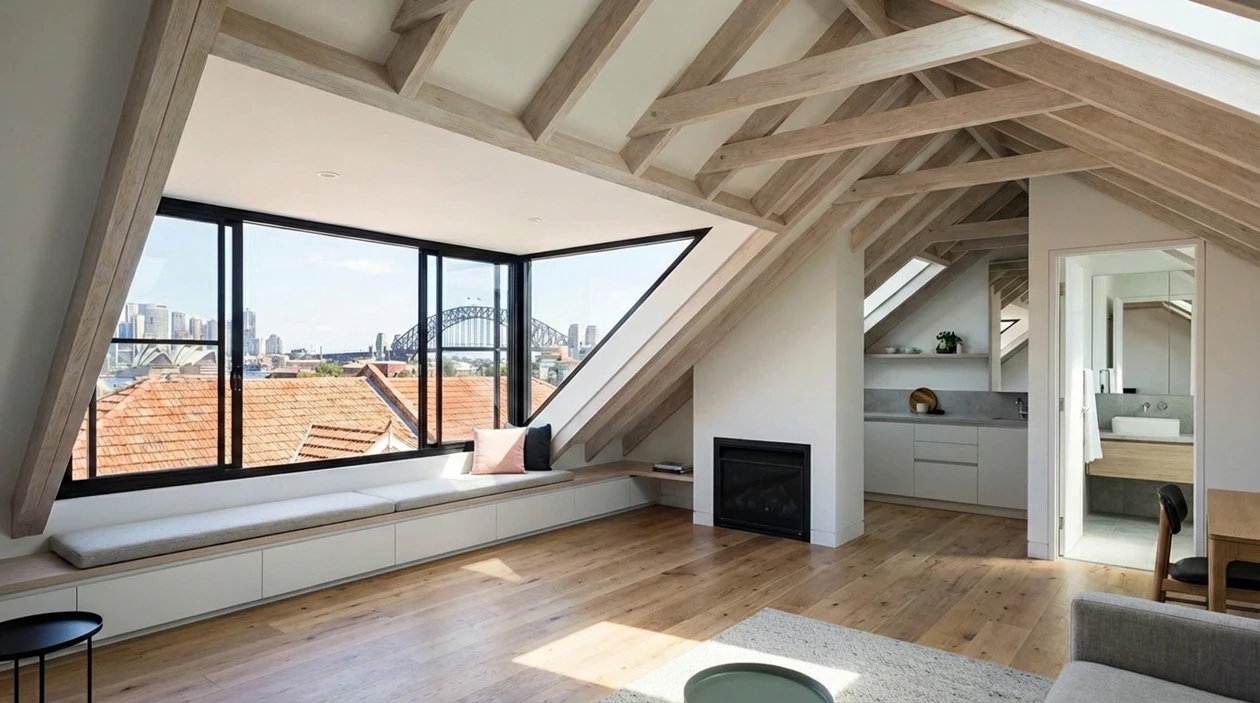
That unused space above your head could be your next bedroom, home office, or the extra bathroom your family desperately needs. But before you start dreaming about skylights and built-in wardrobes, you need answers to three questions: Can it be done? What will it cost? And is it actually worth it?
This guide gives you the tools to answer all three, starting with a tape measure and ending with a clear decision.
Can Your Attic Be Converted? The 3-Step Self-Test
Most homeowners assume their attic is either “too small” or “perfect for conversion” without ever checking. The truth sits somewhere in the middle, and you can figure out where in about fifteen minutes.
The minimum requirements: Under the Building Code of Australia, habitable rooms need a minimum ceiling height of 2.4 metres over at least two-thirds of the floor area. Some attics meet this easily. Others need structural work. And some simply aren’t viable without major (and expensive) roof modifications.
The “7 and 7” concept offers a quick rule of thumb: you need roughly 2.1 metres (7 feet) of head height over an area at least 2.1 metres (7 feet) wide. This isn’t a formal building code requirement, but it’s a practical starting point for determining whether your space is worth investigating further.
Step 1: Measure the Head Height
Grab a tape measure and head into your roof space. Measure from the top of the ceiling joists (where your new floor would sit) straight up to the ridge beam at the highest point.
What you’re looking for:
- 2.7m or more at the ridge: Excellent potential for a full habitable room
- 2.4m to 2.7m: Workable, but may need careful design to maximise usable floor area
- Under 2.4m: Likely limited to storage, or requires a roof lift (significant cost)
Step 2: Check the Roof Pitch
The steeper your roof, the more usable floor space you’ll have. Australian homes typically have roof pitches between 15 and 35 degrees.
Quick visual guide:
- Steep pitch (30°+): Good headroom extends further toward the walls
- Moderate pitch (22-30°): Workable space, but walls may need to start further in
- Low pitch (under 22°): Severely limited standing room; often storage-only territory
Step 3: Floor Space Assessment
Even with perfect height, you need enough floor area for both the room itself and stair access. Building codes require stairs to a habitable attic—pull-down ladders won’t cut it for anything beyond storage.
Consider:
- Stair placement: Where will they go? You’ll lose floor space on the level below
- Minimum room dimensions: A bedroom needs at least 10 square metres of usable floor area
- Dormer potential: If your pitch is low, dormers can push walls outward to create more headroom
Your Quick Decision Matrix
Green light (likely viable): Ridge height 2.7m+, pitch over 25°, floor area over 20 square metres.
Proceed with caution (needs professional assessment): Ridge height 2.4-2.7m, moderate pitch, limited floor area.
Red flag (major work required): Ridge height under 2.4m, low pitch, conversion may cost more than the value it adds.
Real Costs: From Storage Boarding to Full Dormer Conversion
“Can I convert my attic for $10,000?” It’s one of the most common questions, and the honest answer is: not into a habitable room, no.
A basic attic conversion in Australia, one that meets building codes and adds genuine living space, typically starts around $30,000 to $40,000. Full conversions with dormers, bathrooms, and premium finishes can reach $80,000 to $150,000 or more.
Here’s what different budgets actually get you:
The $10,000-$15,000 Budget
What you get: Boarding over joists for light storage, basic insulation, a pull-down ladder, and a light fitting.
What you don’t get: A habitable room. This budget doesn’t cover structural reinforcement, proper stairs, fire safety compliance, or council approval for living space.
Verdict: Storage only. Good for suitcases and Christmas decorations. Not suitable for a home office, bedroom, or any regular use.
The $30,000-$50,000 Budget
What you get: A basic habitable room conversion. This typically includes structural floor reinforcement, fixed stairs, Velux-style roof windows, insulation to current standards, plasterboard lining, electrical work, and basic smoke detection.
Best suited for: A home office, study, or small spare bedroom without ensuite.
Reality check: This budget works when the existing attic has good height and pitch. If structural modifications are needed (collar ties raised, purlins relocated), costs push toward the higher end.
The $50,000-$80,000 Budget
What you get: A well-finished living space with multiple skylights or a small dormer, built-in storage, quality flooring, and potentially plumbing rough-in for a future bathroom.
Best suited for: A comfortable master bedroom, teenager’s retreat, or dedicated home office with proper climate control.
The $80,000-$150,000+ Budget
What you get: The full transformation. Large dormer or multiple dormers, complete bathroom or ensuite, walk-in wardrobe, ducted air conditioning, premium fixtures and finishes.
Best suited for: A genuine master suite addition or multi-room conversion that functions as a self-contained level.
Hidden Costs Checklist
Your quote should include these—but if it doesn’t, budget for them separately:
- Structural engineer fees: $1,500 to $3,000 for calculations and certification
- Building surveyor/certifier: $1,500 to $4,000 depending on your state
- Council fees (if DA required): $500 to $2,000+
- Scaffolding: $2,000 to $5,000 if external access needed
- Stair modifications below: Often forgotten—you’re losing floor space downstairs
- Upgraded electrical board: Older homes often need switchboard upgrades
- Fire safety compliance: Smoke alarms, emergency egress, potentially fire-rated doors
Planning Permission vs. Complying Development: Which One Do You Need?
Not every attic conversion needs a full Development Application to council. But every habitable conversion needs some form of approval and getting this wrong can mean costly rectification work or problems when you sell.
Understanding Your Approval Pathway
Complying Development Certificate (CDC): A faster, simpler approval pathway available when your project meets specific pre-set standards. A private certifier can issue this without council involvement.
Development Application (DA): The full council assessment process, required when your project doesn’t fit the complying development criteria or involves heritage, bushfire, or flood considerations.
The Quick Flowchart
Answer these questions to identify your likely approval pathway:
Does your conversion involve external changes?
- Yes (dormers, raising the roof): More likely to need DA
- No (Velux windows only, internal only): May qualify for CDC
Is your property heritage listed or in a heritage conservation area?
- Yes: DA almost certainly required
- No: Continue to next question
Are you in a bushfire, flood, or coastal zone?
- Yes: Additional requirements apply; DA likely needed
- No: Continue to next question
Does the work comply with the State Environmental Planning Policy (Exempt and Complying Development)?
- Yes: CDC pathway likely available
- No: DA required
A Note on the “10-Year Rule”
Some homeowners have heard about timeframes after which unapproved work becomes immune from enforcement action. In Australia, these rules vary significantly by state and don’t offer the protection many assume.
Even if enforcement becomes statute-barred, unapproved work still creates problems. It won’t appear on your compliance certificates, it may affect insurance coverage, and it can derail property sales when buyers’ solicitors request building records.
The smart approach: Get proper approval upfront. The cost is modest compared to the headaches of unapproved work.
Getting a Complying Development Certificate
If your project qualifies for the CDC pathway:
- Engage a private certifier (Principal Certifying Authority)
- Provide architectural drawings and specifications
- Include structural engineer’s certification
- The certifier assesses against the complying development code
- If compliant, certificate is issued—often within 10-20 business days
Is an Attic Conversion Worth the Investment?
A well-executed attic conversion adds roughly 10-15% to a property’s value. In a home worth $800,000, that’s $80,000 to $120,000 in added value.
That calculation only holds if the conversion is done properly with building approval, quality finishes, and thoughtful design. A poorly executed conversion can add zero value or even reduce it.
Factors that maximise return:
- Adding a bedroom with ensuite (particularly if it takes the home from 3 to 4 bedrooms)
- Creating a self-contained space with separate entry
- Including built-in storage
- Maintaining good natural light and ventilation
Factors that limit return:
- Low ceiling height that feels cramped
- Poor stair access (steep, narrow, or awkwardly placed)
- Cutting corners on finishes
- Missing approvals or compliance certificates
Can I DIY? The Reality Check
Attic conversions attract DIY enthusiasm because they feel contained, it’s “just” an empty space, after all. But the structural, electrical, and compliance requirements make this one of the riskier DIY projects.
Honest skill audit:
- Can you install steel beams and verify load paths?
- Can you calculate and install adequate floor joists for habitable loads?
- Can you run electrical circuits and have them certified?
- Can you install compliant smoke detection and emergency egress?
- Can you plaster a ceiling at height to a finish you’d be proud of?
The Hire vs. DIY Task List
Suitable for competent DIY:
- Demolition and clearing out existing storage
- Installing insulation batts (after structure is in place)
- Painting (after plastering is complete)
- Basic flooring installation
- Assembling flat-pack furniture and storage
Requires licensed professionals:
- Structural modifications (floor reinforcement, collar tie changes, beam installation)
- All electrical work (must be done by a licensed electrician)
- Plumbing (if adding a bathroom)
- Gas fitting (if extending heating)
- Plastering and fire-rated construction
Must be professionally certified:
- Structural engineer sign-off on any load-bearing changes
- Electrical certificate of compliance
- Building inspection and occupancy certificate
Your Next Step
The gap between “thinking about it” and “getting started” is usually just information. Now you have the framework to assess your attic’s potential, understand realistic costs, and navigate the approval process.
If your self-assessment looks promising, your next move is a professional feasibility inspection. A builder experienced in attic conversions can confirm what’s possible in your specific roof space, identify any structural challenges early, and provide a realistic budget, so you can make an informed decision before committing.
Ready to explore what’s possible with your attic? The team at Jonathan Homes specialises in home renovations including attic conversions across Sydney. From initial feasibility assessment through to final sign-off, they handle the structural engineering, council approvals, and quality construction that turns unused roof space into your home’s most valuable room.
Get in touch with Jonathan Homes to discuss your attic conversion project and find out what’s achievable for your home.