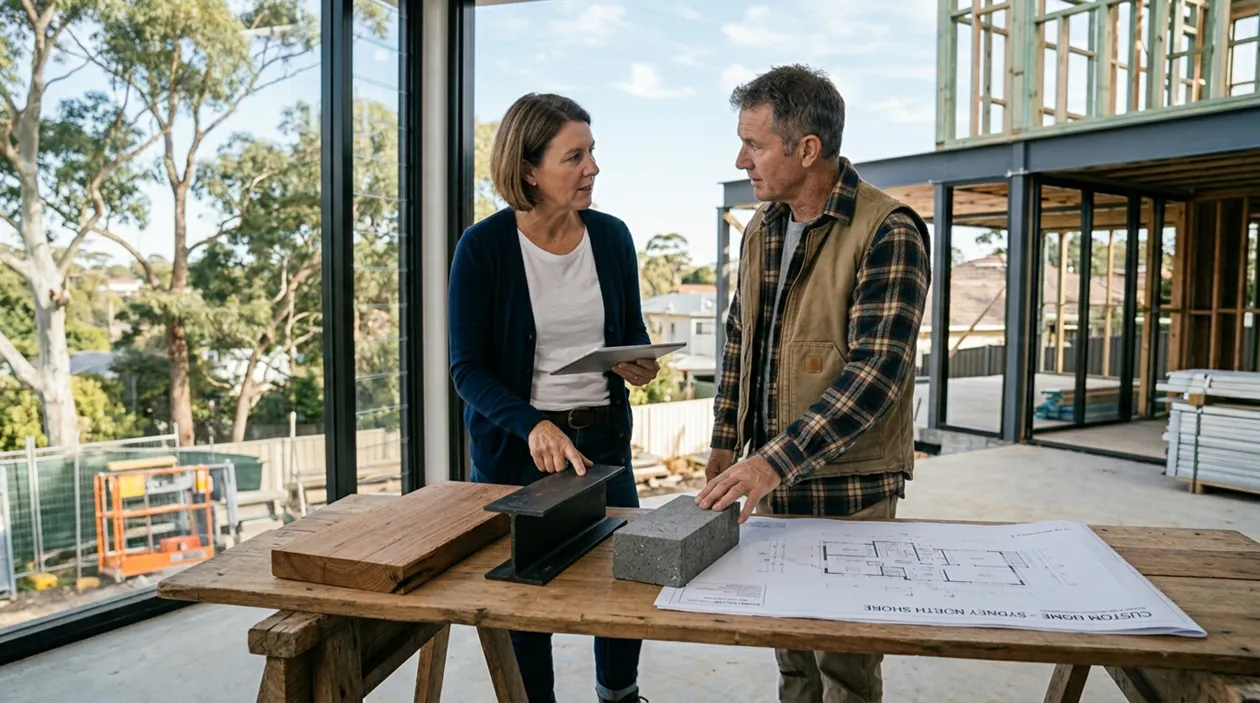
Choosing building materials for a custom home in Sydney comes down to balancing structural integrity, climate suitability, council requirements, and budget. The most common core materials for Sydney custom builds are timber framing, lightweight steel framing, brick veneer, double brick (cavity brick), Hebel autoclaved aerated concrete (AAC), and Insulated Concrete Forms (ICF). The right combination depends on your site, your council’s heritage and bushfire requirements, and how long you want the home to last.
After two generations of building custom homes across Sydney‘s Inner West and beyond, we’ve worked with every major construction system on the market. This guide walks you through the decision framework we use with our own clients — the same matrix, checklists, and step-by-step process that lock in the right material choices before they cost you tens of thousands to change.
Skip ahead: Use the Material Selection Matrix in section 3 to compare materials against your specific site conditions and budget tier. The matrix is the fastest way to narrow your options.
How do I choose the right building materials for my Sydney home?
Choosing the right materials starts with three diagnostic questions. Answer these honestly, and the matrix in the next section will narrow your options dramatically.
The 3-point self-assessment
Question 1: What’s your site’s primary risk profile?
- Coastal salt exposure — Eastern Suburbs, Northern Beaches, Sutherland coast (within 1 km of the ocean)
- Bushfire-prone area with a Bushfire Attack Level (BAL) rating of BAL-12.5 or higher
- Termite-prone area — almost all of Sydney, particularly older Inner West suburbs
- Heritage overlay or conservation area — much of the Inner West and Eastern Suburbs
- High humidity or poor-drainage site
Question 2: What’s your structural budget tolerance?
- Standard: conventional materials and established trades
- Mid-tier (+10–20%): upgraded systems like steel framing or Hebel
- Premium (+25–40%): ICF, SIPs, or full double-brick construction
Question 3: What’s your longevity expectation?
- 50–80 years (standard residential lifespan)
- 100+ years (multi-generational home)
- Heritage match (using materials consistent with the existing streetscape)
Try this now: Before reading further, write down your top two site risks (e.g., coastal salt + termites), your budget tier, and your longevity goal. Keep this in front of you as you read the matrix below.
What’s the strongest material to build a house with in Australia?
For Sydney custom homes, the strongest residential structural systems are double brick (cavity brick), Insulated Concrete Forms (ICF), and Hebel — all of which significantly outperform standard timber framing on fire resistance, termite resistance, structural longevity, and acoustic performance. Lightweight steel framing offers excellent termite resistance and dimensional stability, but its strength advantage over timber is modest in standard residential applications.
The core material comparison matrix
| Material | Cost vs baseline | Termite resistance | Fire resistance | Acoustic | Thermal | Coastal suitability | Best for |
|---|---|---|---|---|---|---|---|
| Timber-frame brick veneer | Baseline | Low (treated pine helps) | Moderate | Moderate | Moderate | Good (with quality fixings) | Standard suburban builds, budget-conscious |
| Steel-frame brick veneer | +5–10% | Excellent | Moderate | Moderate | Moderate | Good (galvanised) | Termite-prone sites, larger spans |
| Double brick (cavity brick) | +15–25% | Excellent | Excellent | Excellent | Good (high thermal mass) | Excellent | Heritage match, longevity, acoustic |
| Hebel (AAC) panels | +10–20% | Excellent | Excellent (4-hour FRL) | Very good | Excellent | Very good (with render) | Bushfire zones, energy efficiency |
| Insulated Concrete Forms (ICF) | +25–40% | Excellent | Excellent | Excellent | Excellent (R-value 22+) | Excellent | Premium thermal performance, longevity |
| Structural Insulated Panels (SIPs) | +20–30% | Good | Good | Good | Excellent | Good | Fast builds, energy-conscious owners |
Decision flowchart
- Coastal site, premium budget? → ICF or double brick with Colorbond roofing
- Bushfire-prone (BAL-29 or higher)? → Hebel, ICF, or non-combustible cladding over a steel frame
- Heritage area (Inner West, Eastern Suburbs)? → Match the existing streetscape — usually double brick or brick veneer with timber details
- Standard suburban site, conventional budget? → Timber frame with brick veneer (still the most common Sydney build)
- Termite-anxious owner? → Steel frame, Hebel, or ICF
For honest cost comparisons before you lock in a material system, see our guide to how much it costs to build a custom home in Sydney — material choice can swing total build cost by 25–35%.
What are the main types of residential construction in Australia?
The National Construction Code (NCC), formerly the Building Code of Australia, sets the construction requirements for residential homes (Class 1a buildings). Unlike the United States system you may have seen online, Australian residential construction is generally classified by primary structural method rather than fire-rating type. The five most common construction methods used in Sydney custom homes are listed below.
| Construction method | How it works | Where you’ll see it |
|---|---|---|
| Timber-framed brick veneer | Timber stud wall does the structural work; a single skin of brick on the outside provides the weatherproof façade | Default Sydney build — most new builds and standard suburban homes |
| Lightweight steel-framed brick veneer | Same idea, but the framing is cold-formed steel — termite-proof and dimensionally stable | Termite-prone sites, larger open-plan designs, knockdown rebuilds |
| Double brick (cavity brick) | Two skins of brick separated by an air cavity — fully load-bearing masonry | Pre-1980s Sydney homes, heritage-area new builds, premium custom builds |
| Hebel (AAC) panels or blocks | Autoclaved aerated concrete used as load-bearing walls or cladding panels — lightweight, fire-resistant, termite-proof | Bushfire zones, BASIX-driven energy-efficient builds |
| Insulated Concrete Forms (ICF) | Polystyrene formwork filled with reinforced concrete — premium structural and thermal performance in one system | Premium custom homes, bushfire zones, multi-generational builds |
Key takeaway
When your builder mentions “brick veneer,” they’re describing a timber or steel frame with a single brick skin on the outside — not a full masonry home. This is the most common build type in Sydney, but it’s structurally and acoustically very different from double brick. If you want the solid feel and acoustic performance of older Sydney homes, you need to specify cavity brick, Hebel, or ICF — not brick veneer.
Real-world application
If you’ve costed a brick veneer home and want to upgrade structural performance without going to full double brick, the most cost-effective options are:
- Switch to a steel frame — termite resistance plus dimensional stability
- Add internal Hebel walls between bedrooms — significant acoustic improvement
- Specify double-glazed windows and upgraded insulation — thermal performance gain that compounds over the life of the home
For a deeper look at how material decisions interact with the design process, read our guide to the custom home design process in Sydney.
When do material decisions get locked in during a custom build?
Material choices need to be made early in the design process. Once you progress past the engineering and Development Application (DA) stage, changing the structural system requires a complete redesign — and the cost runs into tens of thousands of dollars. The table below shows when each major material decision becomes effectively final.
The material decision timeline
| Stage | What happens | Material decisions locked in |
|---|---|---|
| 1. Initial consultation | Site visit, brief, BAL assessment, heritage check | Primary structural system shortlisted (timber, steel, masonry, ICF) |
| 2. Concept design | Preliminary 3D drawings and floor plans | Foundation type, primary structure, broad cladding direction |
| 3. Engineering & DA | Structural engineering, council submission | Structural system fully locked — changing now triggers redesign |
| 4. Detailed design | Selections, finishes schedule, joinery | Cladding, roofing, insulation specification, windows |
| 5. Construction certificate | Final approval before site works begin | All material schedules signed off — variations now cost time and money |
| 6. Site works & framing | Slab, frame, roof on | Internal materials (plasterboard type, acoustic batts, fixtures rough-in) |
| 7. Fit-out & finishes | Joinery, tiling, painting, fixtures | Final visible finishes — relatively easy to vary at this stage |
Common mistakes to avoid
- Changing the structural system after engineering is complete. Switching from timber frame to ICF after engineering plans are stamped means re-engineering the entire structure, foundations included. Cost: $15,000 to $40,000 plus 6–12 weeks of delay.
- Choosing cladding before checking BAL or council heritage requirements. Selecting timber weatherboard for a BAL-29 site, or modern fibre cement for a heritage conservation area, will get rejected at DA stage.
- Underestimating insulation specification. BASIX (NSW Building Sustainability Index) requirements depend on your wall system. ICF easily meets BASIX without additional insulation; brick veneer often doesn’t.
- Specifying premium finishes on a budget structure. Spending $80,000 on Italian tiles inside a budget timber-framed shell is a common upgrade trap. The structural shell drives long-term value.
- Forgetting acoustic performance. Brick veneer transfers sound between rooms far more than double brick or Hebel internal walls. If you have teenagers, home offices, or shared bedrooms, this matters.
What are the biggest threats to building materials in Sydney?
Every material has weak points. Understanding the enemy of each one — and specifying the right protection at the build stage — is what separates a 50-year home from a 150-year home.
Material-specific threats and protection
| Material | Primary threats | Protection strategy |
|---|---|---|
| Concrete (slab, ICF, foundations) | Carbonation, chloride attack (‘concrete cancer’), efflorescence, settlement cracking, sulfate attack from soil | Specify capillary breaks, damp-proof course, correct cover to reinforcement, sulfate-resistant cement on aggressive sites |
| Timber framing | Termites, moisture and rot, fire, fungal decay | AS 3660.1-compliant termite barrier (physical or chemical), H2 or H3 treated pine for high-risk areas, sub-floor ventilation, sarking behind cladding |
| Lightweight steel framing | Corrosion (especially coastal sites), thermal bridging | Galvanised or zinc-aluminium coated steel; stainless steel fixings within 1 km of the coast; thermal break tape behind cladding |
| Brick (veneer or double) | Salt damp, mortar deterioration, efflorescence, cracking from movement | Damp-proof course at base, weep holes for cavity drainage, articulation joints, correct mortar mix for marine exposure |
| Hebel (AAC) | Surface damage, water absorption if unsealed | Acrylic render system, correct flashings at penetrations, paint system rated for AAC |
| Render (over masonry or Hebel) | Cracking, moisture penetration, efflorescence bleeding through | Correct expansion joints, quality acrylic system over a fibreglass mesh, proper flashings |
| Colorbond / metal roofing | Coastal corrosion, thermal expansion noise, sealant failure at penetrations | Coastal-grade Colorbond (Ultra), correct fixings, anti-drumming pads, butyl or silicone seals at flashings |
Pre-sign-off checklist: 5 questions to ask before approving plans
- What’s the termite management system? Look for AS 3660.1 compliance — physical barrier, chemical barrier, or both.
- What’s the waterproofing system at the foundation? Capillary break, damp-proof course, sub-floor ventilation.
- What grade of steel fixings will be used in cladding and roofing? Stainless steel for coastal sites within 1 km of the ocean.
- What’s the BASIX-compliant insulation specification per wall system? R-value targets vary by climate zone — Sydney is climate zone 5.
- What does the structural warranty actually cover, and for how long? Our 7-year structural warranty covers full structural integrity — check yours carefully.
Bringing it together
There’s no single “best” building material for a Sydney custom home. The right answer is the one that matches your site’s risk profile, your budget tier, your council’s controls, and the lifespan you want from the home. The matrix in this guide is the same one we walk every Jonathan Homes client through during initial consultation — it’s how we narrow a dozen viable systems down to the two or three that actually make sense for your specific build.
As a Master Builders Association member with two generations of family building expertise, we’ve seen what happens when the wrong material gets specified for the wrong site. We’ve also seen what happens when it’s done properly: a home that needs nothing more than paint and routine maintenance for 50 years. For projects where existing material specification matters most — like our heritage restoration work — getting these decisions right at the start is the difference between a successful build and a costly redesign.
Every Jonathan Homes custom home build comes with a 7-year structural warranty that exceeds industry standards, fixed-price contracts with guaranteed timelines, and a single point of contact — Jonathan — from initial consultation through to handover.
Talk to Jonathan
Call Jonathan on 0414 595 933 for a free consultation, or get in touch via our contact page. Builders Licence 359604C. Servicing Sydney’s Inner West and beyond.