The kitchen is the room that makes or breaks a home. It is where your family gathers in the morning, where dinner parties take shape, and where the quality of your build or renovation is most visible every single day. Whether you are renovating an existing kitchen or designing one from scratch in a new build, getting the layout, materials and budget right from the outset saves money, avoids rework, and delivers a space that genuinely fits the way you live.
The difference between a kitchen renovation and a kitchen designed as part of a custom home build comes down to constraints. A renovation works within existing walls, plumbing positions and structural limitations. A custom build starts with a blank canvas, every dimension, every finish and every appliance position is designed around your household’s specific routines. Both paths benefit from the same design principles, but a custom build gives you complete freedom to apply them without compromise.
This guide walks you through the four decisions that matter most regardless of your project type: whether your budget matches your scope, which design tools are worth your time, how to plan a layout that actually works, and which colour and material combinations define a modern Sydney kitchen. Each section gives you a specific framework you can apply before your next design meeting, whether that is with a renovation contractor or a custom home builder in Sydney.
Is $10,000 or $20,000 Enough for a Kitchen Renovation?
It depends entirely on the scope of work. A $10,000 budget covers a cosmetic refresh, new doors, hardware and benchtops on existing cabinets. A $20,000 budget stretches to new off-the-shelf cabinetry and updated appliances. If you are planning a full kitchen renovation with structural changes, relocated plumbing or premium stone benchtops, the realistic starting point for a Sydney project is $30,000 and upward. For a kitchen designed as part of a custom home build, expect $80,000–$180,000+ as you are building from scratch.
The gap between what homeowners expect and what their budget allows is the single biggest source of frustration we see on kitchen projects, in renovations and new builds alike. The scope calculator below helps you match your wishlist to a realistic price bracket before you start requesting quotes.
Kitchen Scope-of-Work Calculator
Select the option that best describes your project for each category. Your score updates instantly.
Plumbing & Electrical
Cabinetry
Benchtops
Cosmetic Refresh
$5,000 – $10,000
Your project scope fits a cosmetic refresh. $10,000 is enough — focus on paint, updated cabinet doors, new hardware and budget-friendly benchtops.
- Paint and cabinet door replacements
- New handles and hardware
- Laminate or budget benchtops
- No plumbing or electrical changes
Want a precise quote for your kitchen project?
Get Your Free ConsultationOr call Jonathan on 0414 595 933
Renovation vs Custom Build: Where the Money Goes
Understanding where your kitchen budget is allocated helps you make smarter trade-offs. The breakdown below applies to both renovations and new builds — the percentages stay remarkably consistent, but the dollar amounts scale with project complexity.
| Component | % of Budget | Renovation Range | Custom Build Range | Key Considerations |
|---|---|---|---|---|
| Custom cabinetry | 30–40% | $6,000–$30,000 | $25,000–$70,000 | Biggest single cost. Polyurethane (2-pac) finishes vs laminate makes the largest price difference. |
| Benchtops | 10–15% | $2,000–$8,000 | $4,000–$25,000 | Engineered stone (Caesarstone, Dekton) is the Sydney standard. Natural stone and porcelain cost more. |
| Appliances | 15–20% | $3,000–$15,000 | $8,000–$35,000 | Integrated appliances (panel-ready dishwasher, built-in ovens) add 20–30% over freestanding. |
| Plumbing and electrical | 10–15% | $2,000–$8,000 | $5,000–$18,000 | Moving gas or water lines is expensive in a renovation. New builds route services from scratch. |
| Splashback and tiling | 5–10% | $1,000–$5,000 | $2,000–$12,000 | Full-height tiled splashbacks cost more but create a premium, seamless look. |
| Lighting and fixtures | 5–8% | $800–$3,000 | $2,000–$8,000 | Recessed LED downlights, under-cabinet strips and pendant lights over islands. |
| Installation and labour | 10–15% | $3,000–$10,000 | $8,000–$20,000 | Licensed builder coordination of electricians, plumbers, tilers, cabinet makers. |
The luxury goods tier — imported Italian cabinetry, marble benchtops, commercial-grade appliances and bespoke metalwork — can push a Sydney kitchen well past $200,000 in a custom home build. These are statement kitchens where every component is individually manufactured to specification, often with lead times of 12–16 weeks for imported hardware.
For a detailed breakdown of renovation-specific pricing, see our guide to kitchen renovation costs in Sydney.
Whether you are renovating or building new, our kitchen renovation services page covers the full process from design through to completion.
Action step: Finalise your non-negotiables using the scope calculator above, then request quotes for the highest-cost items first (cabinetry and benchtops). These two components alone account for 40–55% of the total kitchen budget, so locking in their cost early gives you a realistic ceiling for everything else.
Can AI Design My Kitchen for Free?
Yes. Several free tools can generate kitchen layouts and 3D visuals, but the right platform depends on whether you need a quick mood board or precise floor plan measurements your builder or contractor can work from. Free tools are useful for exploring ideas early in the process, they are not a replacement for professional design, but they help you arrive at your first consultation with a much clearer picture of what you want.
At Jonathan Homes, we use in-house 3D modelling software to produce fully dimensioned kitchen designs that go straight to our cabinetry and trades teams. Whether you are renovating or building a custom home, testing your ideas in a free tool first makes your design consultations significantly more productive.
Comparison: Top Free Kitchen Design Tools
| Feature | Planner 5D (AI) | SketchUp Free | IKEA Kitchen Planner |
|---|---|---|---|
| Best for | Instant AI-generated room ideas | Precise custom measurements | Immediate pricing and shopping lists |
| Learning curve | Very low | High | Medium |
| Output | 3D renders | Scaled blueprints | 3D plan + itemised cart |
| Custom dimensions | Limited | Full control | Constrained to IKEA modules |
| Best project type | Mood boards for any project | Custom builds and major renovations | Budget renovations and flat-pack kitchens |
Which Tool Should You Use?
If you want to see different colour and style ideas quickly, use Planner 5D. If you need exact measurements for a custom builder or major renovation, use SketchUp. If you are pricing a flat-pack kitchen for a rental or investment property, the IKEA Kitchen Planner gives you a shopping list in minutes.
For a custom home build, the most productive approach is to use a free tool like Planner 5D to collect visual references and layout preferences, then bring those to your builder’s design consultation. Your builder’s in-house designers will translate your preferences into a fully engineered kitchen plan that accounts for structural constraints, services routing and Australian manufacturing standards. The same approach works for major renovations, the more prepared you are, the faster the design process moves.
Before You Open Any Design Tool
Measure your wall lengths and ceiling height. For a renovation, measure the existing kitchen. For a new build, pull dimensions from your floor plans.
Photograph your current kitchen from each corner (renovation) or collect 5–10 reference images of kitchens you like (new build).
List your must-have appliances (double oven, induction cooktop, integrated fridge) — these dictate minimum clearances and zone sizing.
Note how many people cook at the same time. A single-cook household and a two-cook household need very different layouts.
Our custom home design process guide explains how your kitchen layout fits into the broader design-to-build workflow for new homes
How Do I Design My Kitchen Layout?
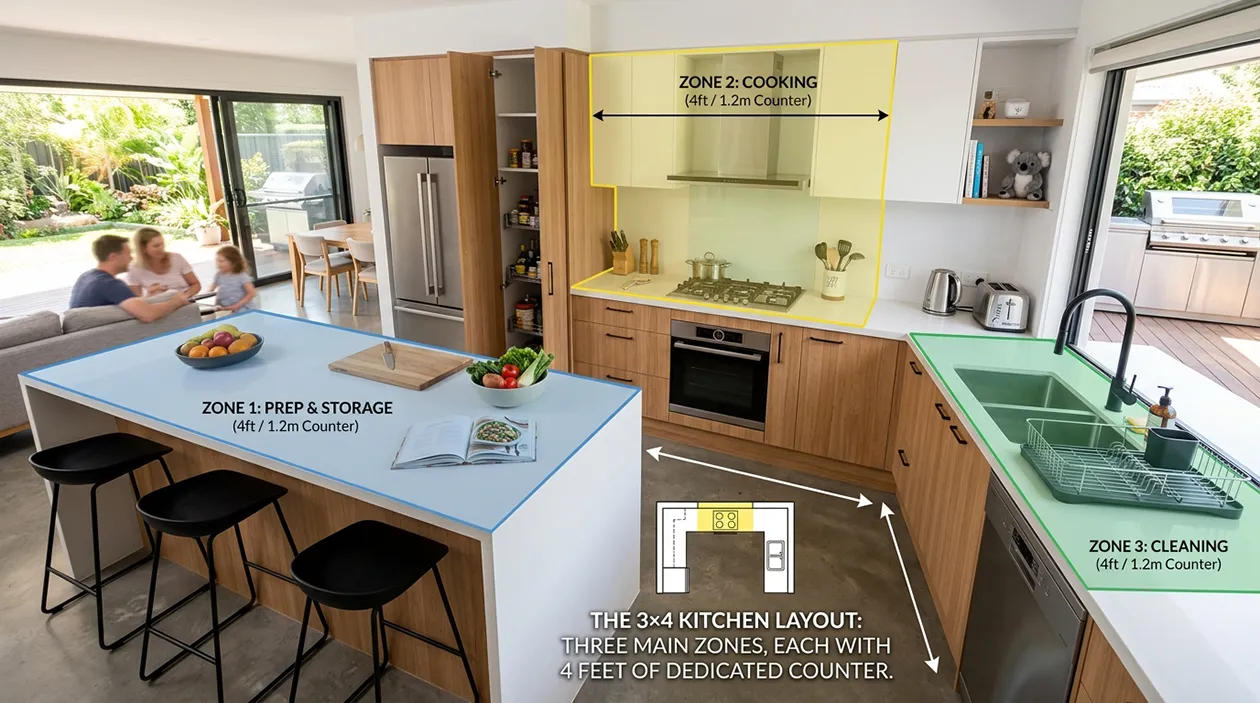
The most effective way to design a kitchen layout is by applying the 3×4 zone rule. This principle divides your kitchen into three distinct, 1.2-metre functional zones — prep, cooking and cleaning — to maximise efficiency and workflow. Combined with the classic work triangle, it ensures no wasted steps between your sink, fridge and cooktop. The rule applies equally whether you are redesigning an existing kitchen or planning one in a new home.
Layout is the single decision that has the biggest long-term impact on how your kitchen functions. Materials and finishes can be updated over time; a poorly planned layout is locked in for years. In a renovation, you may be constrained by existing plumbing and structural walls — but the zone principles still apply within those boundaries. In a custom build, you have complete control over where every zone sits, which is why getting this right at the design stage matters more than any other room in the house.
The 3×4 Layout Mapping Method
Whether you are testing your current kitchen or planning a new one, grab a tape measure and some painter’s tape. Mark these three zones on your floor plan:
Zone 1 — Cleaning (1.2 metres): This zone centres on the sink and dishwasher. Ensure the dishwasher door can fully open without blocking a walkway. In a new build, position the sink under a window or on the island where natural light is strongest. In a renovation, work with the existing sink position unless your budget extends to relocating plumbing.
Zone 2 — Prep (1.2 metres): This is continuous, uninterrupted benchtop space between the fridge and the sink. No appliances, no cooktop, no rangehood — just clear workspace. This is the zone most Sydney kitchens get wrong by making it too small, whether renovated or newly built.
Zone 3 — Cooking (1.2 metres): The cooktop, oven and rangehood zone. Allow at least 400 mm of landing space on either side of the cooktop for hot pans and utensils.
The work triangle check: Measure the walking distance between the centre of the sink, fridge and cooktop. The total perimeter of these three paths should be between 4 and 8 metres. Shorter than 4 metres and the kitchen feels cramped; longer than 8 metres and you are wasting steps.
Which Layout Fits Your Space?
The right kitchen layout depends on the shape and size of your floor plan — and whether you are working within existing walls or starting fresh. Here are the five most common configurations and when each one makes sense:
| Layout | Best For | Min. Width | Work Triangle | Renovation or New Build? |
|---|---|---|---|---|
| Galley | Narrow floor plans, townhouses, compact homes | 2.4 m between walls | Excellent — tight, efficient | Both. Common renovation layout where walls cannot be removed. |
| L-shaped | Open plan living, medium floor plans | 3.0 m on longest wall | Good — natural triangle | Both. The most popular renovation layout when opening up to a living area. |
| U-shaped | Dedicated kitchen rooms, larger homes | 3.6 m between walls | Excellent — all three zones within reach | Both. Works well in older Sydney homes with separate kitchen rooms. |
| Island | Open plan homes, entertaining | 4.2 m total (1.2 m island + 1.0 m clearance each side) | Good — island hosts prep or cooking zone | Primarily new builds. Renovations require enough floor space after wall removal. |
| Peninsula | Open plan homes where a full island does not fit | 3.4 m | Good — similar to L-shape with added bench space | Both. A practical compromise when the space is too narrow for a full island. |
For open plan living — whether achieved through a renovation knock-through or designed into a custom home — the island layout is the most popular choice across our Sydney builds. It creates a natural dividing point between the kitchen and living zones without closing off sightlines, which is critical when designing connected spaces that flow into dining and lounge areas.
Self-Check: The Pasta Test
Walk through the motion of making pasta in your planned layout (or your current kitchen if renovating). Take vegetables from the fridge, wash them at the sink (Cleaning Zone), chop them on the bench (Prep Zone), and cook them at the stove (Cooking Zone).
Can you complete the sequence without retracing your steps more than once? If yes, your layout is well optimised. If you are zigzagging back and forth, the zones need rearranging.
Fridge placement tip: Position the fridge at the outermost edge of your kitchen layout, closest to the entry point. This prevents family members from walking through the cooking and prep zones just to grab a drink — the most common kitchen traffic conflict in open plan homes. This applies equally to renovations and new builds.
How to Apply the 60-30-10 Rule for Kitchen Colour Trends
The 60-30-10 rule is an interior design formula that balances room colours: 60% of the visual space is a dominant base colour, 30% a secondary tone, and 10% an accent colour. Applying this ratio prevents kitchens from looking either chaotic or sterile, and it integrates naturally with the warm, textured materials that define kitchen design, regardless of whether you are refreshing an existing kitchen or selecting finishes for a brand-new one.
Sydney kitchen design has shifted decisively away from the all-white, handleless look that dominated the past decade. The trend is toward warmth, natural texture and tactile materials, kitchens that feel grounded and inviting rather than clinical. Here is exactly how to apply the 60-30-10 rule using current materials and palettes.
The “Warm Earth” Formula
| Proportion | Element | 2026 Direction | Specific Actions |
|---|---|---|---|
| 60% — Dominant | Cabinetry and walls | Warm, grounded neutrals | Soft beige, mushroom, creamy off-white or sage green for cabinet fronts and walls. Avoid stark white. |
| 30% — Secondary | Benchtops and flooring | Tactile, natural materials | Timber flooring (engineered oak is the Sydney standard), textured engineered stone or concrete-look benchtops. |
| 10% — Accent | Hardware, tapware and fixtures | Warm metallic finishes | Brushed brass, soft bronze or brushed nickel for handles, tapware and pendant lights. Avoid high-polish chrome. |
In a renovation, the 60-30-10 rule helps you decide which elements are worth replacing and which can stay. If your existing cabinetry is structurally sound but the wrong colour, repainting or refacing the doors (the 60% layer) has the biggest visual impact for the lowest cost. If your benchtops are dated, swapping them (the 30% layer) transforms the feel of the room. Updating handles and tapware (the 10% layer) is the quickest and cheapest refresh of all.
In a custom build, you are selecting every layer from scratch. The manufacturing quality of your cabinetry is what determines how well these colour and material choices hold up over time. Two-pac (polyurethane) painted cabinetry delivers the smoothest, most durable finish for coloured cabinets and is the standard for custom kitchens in Sydney. Laminate finishes have improved significantly and offer a budget-friendly alternative for renovations, but they do not hold colour depth or edge profiles as well as two-pac.
Materials That Make the Difference
Whether you are choosing materials for a renovation or selecting finishes for a custom build, these are the options that have the biggest impact on both aesthetics and durability:
| Material | Application | Price Tier | Durability | Best For |
|---|---|---|---|---|
| Engineered stone | Benchtops | Mid–high ($800–$1,500/m²) | Excellent — scratch and stain resistant | Most kitchens — the Sydney default for renovations and custom builds alike. |
| Natural stone (marble, granite) | Benchtops, splashbacks | High ($1,200–$3,000+/m²) | Varies — marble stains, granite is harder | Luxury kitchens, statement islands in custom builds. |
| Porcelain slab | Benchtops, splashbacks | High ($1,000–$2,000/m²) | Excellent — UV, heat and scratch resistant | Outdoor kitchens, contemporary custom homes. |
| Two-pac (polyurethane) | Cabinetry doors | Mid–high | Very good — repairable if chipped | Custom colour matching in new builds. Also used for high-end renovation refacing. |
| Laminate | Cabinetry doors, benchtops | Budget–mid | Good — newer laminates resist moisture well | Budget renovations, rental properties, cosmetic refreshes. |
| Timber veneer | Cabinetry doors, open shelving | Mid–high | Good — requires sealing | Adding warmth to contemporary kitchens — works in both renovations and new builds. |
| Brushed brass / bronze | Tapware, handles, fixtures | Mid–high | Good — quality varies by manufacturer | Accent layer (the 10% in 60-30-10). Easiest upgrade in a renovation. |
When selecting materials, always request physical samples and view them under the lighting conditions of your actual kitchen space. Engineered stone, in particular, can look dramatically different under showroom downlights versus the natural light in a north-facing Sydney kitchen. Your builder or renovation contractor should arrange sample viewing as a standard part of the interior design consultation.
The Colour Self-Check
Stand at the entrance to your kitchen (or study your 3D render from the entry angle). If your eyes dart around the room, the 10% accent colour is taking up too much visual space — usually because hardware or a splashback feature is too prominent. If the room feels flat and monotone, you are likely missing the 30% secondary texture layer.
If your kitchen opens into a dining or living area — as most Sydney kitchens now do, whether renovated or purpose-built — carry at least one material (typically flooring or a benchtop tone) through the transition to create visual continuity. This is one of the key interior design principles that separates a cohesive kitchen from one that feels disconnected from the rest of the home.
Design Your Kitchen with Jonathan Homes
Whether you are renovating a tired kitchen or designing the centrepiece of a brand-new custom home, the principles are the same: get the layout right first, match your budget to your scope, and choose materials that will look and perform as well in ten years as they do on day one.
At Jonathan Homes, we handle both, kitchen renovations that transform existing homes and fully custom kitchens designed from scratch as part of a new build. Every kitchen is designed in-house using 3D modelling, then built by our licensed trades team under Jonathan’s direct supervision. You deal with one person from initial design through to the final appliance installation — no subcontractor handoffs, no communication gaps.
We are a family-owned building company in Sydney with two generations of construction expertise, a 5.0-star Google rating across 27 five-star reviews, and a 7-year structural warranty that exceeds industry standards. Every project is delivered as a fixed-price contract with guaranteed timelines.