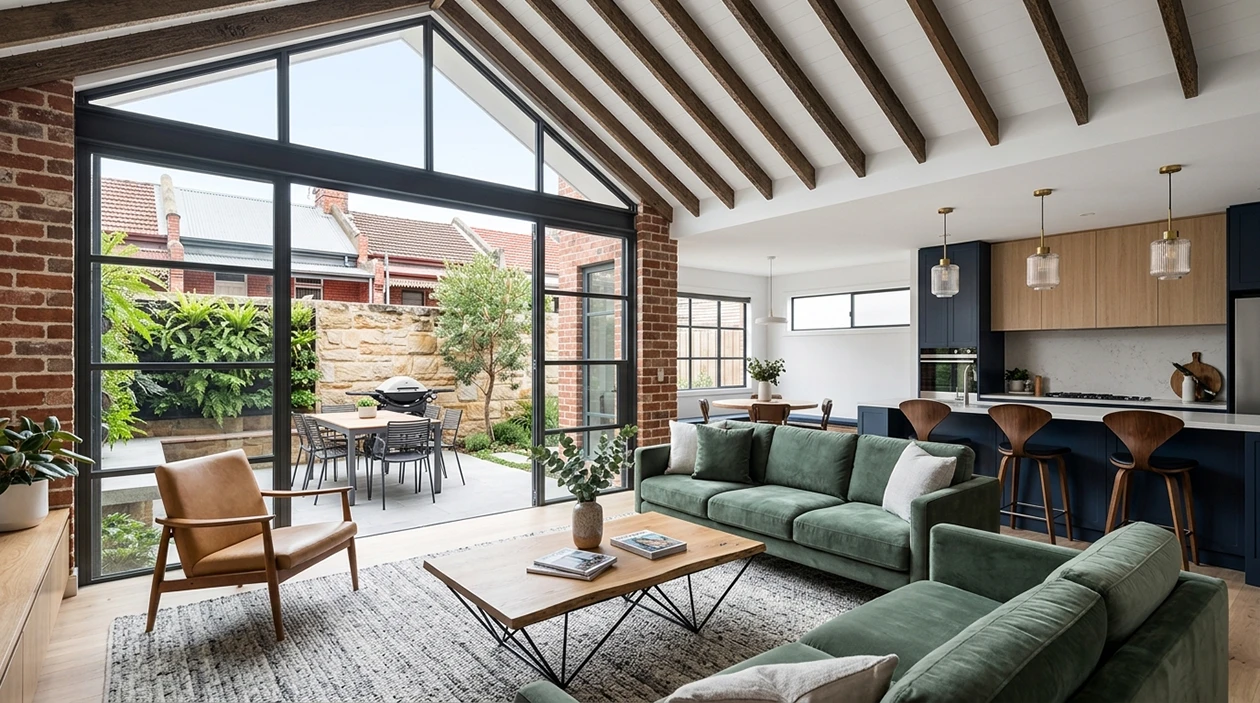
Open plan living is an architectural approach that removes internal walls to combine the kitchen, dining, and living areas into one connected space. It maximises natural light, improves social interaction, and creates a sense of spaciousness — but it needs to be designed carefully to avoid noise issues, poor zoning, and wasted space.
If you’re building a custom home in Sydney, one of the biggest design decisions you’ll make is how your living spaces connect. Open plan layouts have dominated Australian home design for over a decade, and for good reason — they suit our climate, our lifestyle, and the way modern families use their homes.
But open plan isn’t simply about knocking down walls and hoping for the best. A well-designed open plan home considers ceiling heights, window placement, flooring continuity, acoustic management, and how each zone within the space serves a distinct purpose. Get these details right and you’ll have a home that feels spacious, functional, and connected. Get them wrong and you’ll end up with a cavernous room that’s noisy, hard to heat, and impossible to furnish.
At Jonathan Homes, we design and build custom homes across Sydney’s Inner West with open plan living at the heart of most projects. As a family-owned custom home builder with two generations of construction expertise, we’ve seen firsthand what works — and what creates problems down the track. This guide walks you through everything you need to know about designing open plan spaces that actually function for real life.
Are Open Floor Plans Going Out of Style in 2026?
No, open floor plans are not outdated. However, the trend is shifting from completely wall-free layouts toward “broken plan” designs that use half-walls, glass partitions, and varied ceiling heights to create defined zones while maintaining visual flow and natural light.
The massive, wall-less “bowling alley” layout that was popular through the 2010s is losing favour. Homeowners — particularly those who work from home — are realising that a single, uninterrupted room doesn’t always suit every stage of family life. Noise from the kitchen interrupts video calls. Cooking smells drift through the entire ground floor. And there’s nowhere to retreat for quiet reading or focused work.
The solution isn’t to go back to small, separated rooms. It’s to design with intent — using architectural elements like stepped ceiling heights, strategically placed walls, glazed doors, and material changes underfoot to define distinct zones within an open layout. This is what designers now call “broken plan” living, and it’s the approach we recommend for most custom home builds in Sydney.
Open Plan vs Broken Plan: What’s the Difference?
| Criteria | Traditional Open Plan | Broken Plan |
|---|---|---|
| Acoustics | Poor — noise travels freely across the entire space | Good — partial walls and screens absorb and deflect sound |
| Privacy | Minimal — every activity is visible from every angle | Moderate — defined zones allow retreat without full separation |
| Natural Light | Excellent — uninterrupted flow from windows across the full space | Very good — glass partitions and half-walls maintain light flow |
| Heating & Cooling | Higher costs — large volumes are harder to zone efficiently | Lower costs — defined areas can be heated or cooled independently |
| Resale Appeal | Strong — remains popular with buyers who value spaciousness | Growing — increasingly preferred by families with WFH needs |
| Best For | Couples, entertainers, compact sites where space is limited | Families, WFH households, larger builds with flexible room needs |
Is Your Current Open Plan Working? A Quick Self-Audit
If you’re living in an open plan home and considering a custom build or major renovation, use this checklist to evaluate whether your current layout is actually serving you well.
| Question | Yes / No |
|---|---|
| Does noise from the kitchen interrupt conversation or TV in the living zone? | |
| Is kitchen mess (dirty dishes, prep clutter) visible from the front entrance? | |
| Do you lack a quiet, dedicated space for working from home? | |
| Is it difficult to heat or cool the space efficiently in winter or summer? | |
| Does the room feel echoey or acoustically harsh? |
If you answered “yes” to two or more questions, your current open plan could benefit from the zoning techniques we cover in the next sections — or from a purpose-designed broken plan layout in your new custom home.
How to Zone an Open Plan Living Space (Without Building Permanent Walls)
You can effectively zone an open plan space using changes in ceiling height, floor material transitions, furniture placement, pendant lighting clusters, acoustic timber screens, sliding glass doors, or strategically placed storage joinery.
Zoning is the single most important design consideration in open plan living. Without defined zones, a large room feels directionless. Guests don’t know where to sit. The kitchen bleeds into the dining area. The TV competes with cooking noise. Every element of the space should signal its purpose — and that’s achieved through design, not just furniture arrangement.
Ceiling Height Changes
Varying the ceiling height is one of the most powerful zoning tools in a custom home build. A higher ceiling over the living area creates a sense of volume and importance, while a lower ceiling over the dining or kitchen zone creates intimacy. In a two-storey custom home, this can be achieved by using the floor structure of the upper storey to create natural ceiling variations on the ground floor.
Floor Material Transitions
Switching from timber floorboards in the living zone to polished concrete or large-format tiles in the kitchen zone creates a visual and tactile boundary. The transition doesn’t need a threshold strip — a clean, flush joint between materials is the contemporary approach and maintains the connected feel.
Furniture as Boundaries
A long sofa placed perpendicular to the wall creates an instant visual break between living and dining zones. A kitchen island bench serves the same purpose between the cooking and eating areas. The key is ensuring the furniture is scaled correctly for the space — undersized pieces get lost in large rooms and fail to define the zone.
Glazed Doors and Screens
Steel-framed glass doors (often called Crittall-style) or acoustic timber slat screens allow you to close off a zone when you need sound separation — while maintaining visual connection and light flow. These are particularly effective between the kitchen and a home office or study nook that’s been incorporated into the open plan layout.
Lighting Zones
Each zone within an open plan space should have its own dedicated lighting scheme. Pendant lights over the dining table, downlights in the kitchen, and floor or table lamps in the living area allow each zone to operate independently at night. This is where your custom home lighting design becomes critical — planning the electrical layout during the design phase avoids costly retrofitting later.
Key Architectural Elements for Open Plan Living
The most important architectural elements in open plan design are window placement for cross-ventilation and natural light, wall positioning for structural and acoustic purposes, door selection for flexible separation, and ceiling design for spatial definition.
Windows and Natural Light
Open plan spaces rely heavily on natural light to feel warm and liveable. In Sydney, north-facing windows are ideal for the main living zone — they capture consistent daylight without the harsh afternoon glare of western exposure. Floor-to-ceiling windows and corner glazing amplify the effect, drawing the eye through the space and blurring the boundary between indoor and outdoor living.
Cross-ventilation is equally important. In an open plan layout, windows positioned on opposite walls allow air to flow through the entire space, reducing reliance on air conditioning during Sydney’s warmer months. Louvre windows and bifold doors that open to an outdoor entertaining area are standard inclusions in most of our custom home builds.
Walls: Strategic, Not Decorative
In open plan design, every wall that remains must earn its place. Some walls are load-bearing and can’t be removed without significant structural engineering — steel beams, posts, or engineered timber can replace them, but this adds cost. Other walls serve acoustic, privacy, or storage purposes. A half-wall behind a sofa, for example, conceals the back of the kitchen while creating a shelf for styling or a discreet power point for charging devices.
Doors That Flex
Cavity sliding doors and bifold doors give you the option of opening or closing a zone as needed. This is particularly valuable for a guest bedroom, media room, or home office that adjoins the main living area. When the doors are open, the space feels connected. When closed, you have genuine acoustic separation. In heritage homes across Sydney’s Inner West, we often restore original timber doors and incorporate them into a contemporary open plan layout to maintain character.
Ceiling Design
Beyond height variation, ceiling materials and finishes play a role in defining the feel of an open plan space. Exposed timber beams create warmth and a sense of craftsmanship. Flat plasterboard ceilings with shadow-line cornices suit a clean, contemporary aesthetic. Raking ceilings that follow the roofline add drama and volume to single-storey homes where the ceiling height would otherwise be limited to the standard 2.7 metres.
How to Furnish an Open Plan Living Space: The Essential Design Rules
Furnishing an open plan space requires creating visual boundaries using rugs, lighting, and colour theory. Designers rely on proportional rules — the 60-30-10 colour rule, the 2/3 proportion rule, the 3-5-7 grouping rule, and the kitchen work triangle — to anchor furniture and prevent the space from feeling cluttered or empty.
One of the most common mistakes in open plan living is furnishing the space as though it’s one room. It’s not — it’s multiple rooms that happen to share the same floor and ceiling. Each zone needs its own anchor piece (a dining table, a sofa, an island bench) and its own area rug, lighting, and colour treatment.
The Design Formulas That Work
| Design Rule | How It Works | Open Plan Application |
|---|---|---|
| 60-30-10 Rule | 60% dominant colour (walls, large sofa), 30% secondary (rug, curtains), 10% accent (cushions, art) | Creates visual cohesion across a large, connected space without walls to break colour |
| 2/3 Proportion Rule | Sofa = 2/3 the length of the rug. Coffee table = 2/3 the length of the sofa. Art = 2/3 the width of furniture below | Prevents furniture from looking lost in oversized rooms by maintaining proportional relationships |
| 3-5-7 Rule | Group decorative items in odd numbers: 3 on a coffee table, 5 on a mantle, 7 on a bookshelf | Adds visual rhythm and avoids the “show home” feel that large open areas can create |
| Kitchen Work Triangle | Sink, fridge, and cooktop form a triangle. No leg shorter than 1.2 m or longer than 2.7 m | Critical in open plan kitchens where the cooking zone must function efficiently within the larger space |
These formulas aren’t arbitrary — they’re the same principles interior designers apply to create spaces that feel balanced and intentional. In a custom home, you have the advantage of designing the room dimensions around the furniture layout, rather than the other way around. We work with our clients during the custom home design process to ensure the floor plan accommodates their furniture preferences before a single wall goes up.
How Much Does an Open Plan Renovation Cost in Sydney?
An open plan renovation in Sydney typically costs between $50,000 and $150,000 depending on whether load-bearing walls need removal, the quality of kitchen and flooring finishes, and whether structural engineering and council approvals are required.
If you’re converting an existing home to open plan, the single biggest cost variable is structural wall removal. Removing a load-bearing wall requires a structural engineer’s report, a steel or engineered timber beam to carry the load, and potentially new footings — this alone can cost $10,000–$25,000 before any finishes are touched.
Typical Cost Breakdown for an Open Plan Renovation
| Work Category | Typical Cost Range (Sydney) | Share of Budget |
|---|---|---|
| Structural wall removal (load-bearing) | $10,000–$25,000 | 15–25% |
| Kitchen costs such as cabinetry, benchtops and island | $15,000–$40,000 | 25–35% |
| Flooring (continuous through zones) | $5,000–$15,000 | 8–12% |
| Electrical, lighting and data points | $3,000–$10,000 | 5–10% |
| Plastering, painting and finishing | $4,000–$12,000 | 8–12% |
| Windows, doors and glazing | $5,000–$20,000 | 10–15% |
| Contingency | 5–10% of total | 5–10% |
For a ground-up custom home build, the open plan layout is designed from the outset, so there are no demolition or structural retrofit costs. The investment goes into getting the design right — ceiling heights, window sizing, flooring selection, and the kitchen island that anchors the entire space. Jonathan Homes provides fixed-price contracts with guaranteed timelines, so you know exactly what your open plan living space will cost before construction begins.
Common Open Plan Design Mistakes to Avoid
Using short furniture to divide zones
A low console or narrow side table won’t block noise or sightlines. If you’re using furniture as a zone divider, it needs to be at least 900 mm tall — a tall bookcase, a kitchen island, or a media unit with storage.
Blocking natural light with solid screens
Solid timber or plasterboard screens defeat the purpose of open plan design. If you need a visual barrier, use glass, timber slats with gaps, or open shelving that allows light to pass through.
Forgetting about acoustics
Hard surfaces — polished concrete floors, glass splashbacks, plasterboard ceilings — amplify noise in large open spaces. Introduce soft materials like rugs, upholstered furniture, curtains, and acoustic panels to absorb sound. This is especially important in double-height or two-storey open plan spaces where sound travels vertically.
One lighting circuit for the whole space
A single bank of downlights illuminating the entire open plan area creates a flat, uninviting atmosphere. Each zone needs its own circuit and its own light style — pendants for the dining table, task lighting for the kitchen, and ambient lamps for the living zone.
Ignoring the view from the front door
Consider what guests see when they walk in. If the first thing visible is kitchen mess, you’ve got a layout problem. A well-designed open plan positions the living and dining areas in the primary sightline, with the kitchen set to one side or slightly recessed.
Design Your Open Plan Custom Home with Jonathan Homes
Open plan living works best when it’s designed with purpose from the ground up. As a family-owned Sydney custom home builder with a 5.0-star Google rating, Master Builders Association membership, and a 7-year structural warranty on every project, Jonathan Homes delivers open plan homes that are built for the way your family actually lives.
Every project is personally managed by Jonathan from first consultation through to handover. We offer fixed-price contracts, in-house 3D design, and guaranteed timelines — so you can see your open plan layout in detail before construction begins.
Call Jonathan on 0414 595 933 or visit our contact page to book your free consultation and start designing the connected living spaces your family deserves.