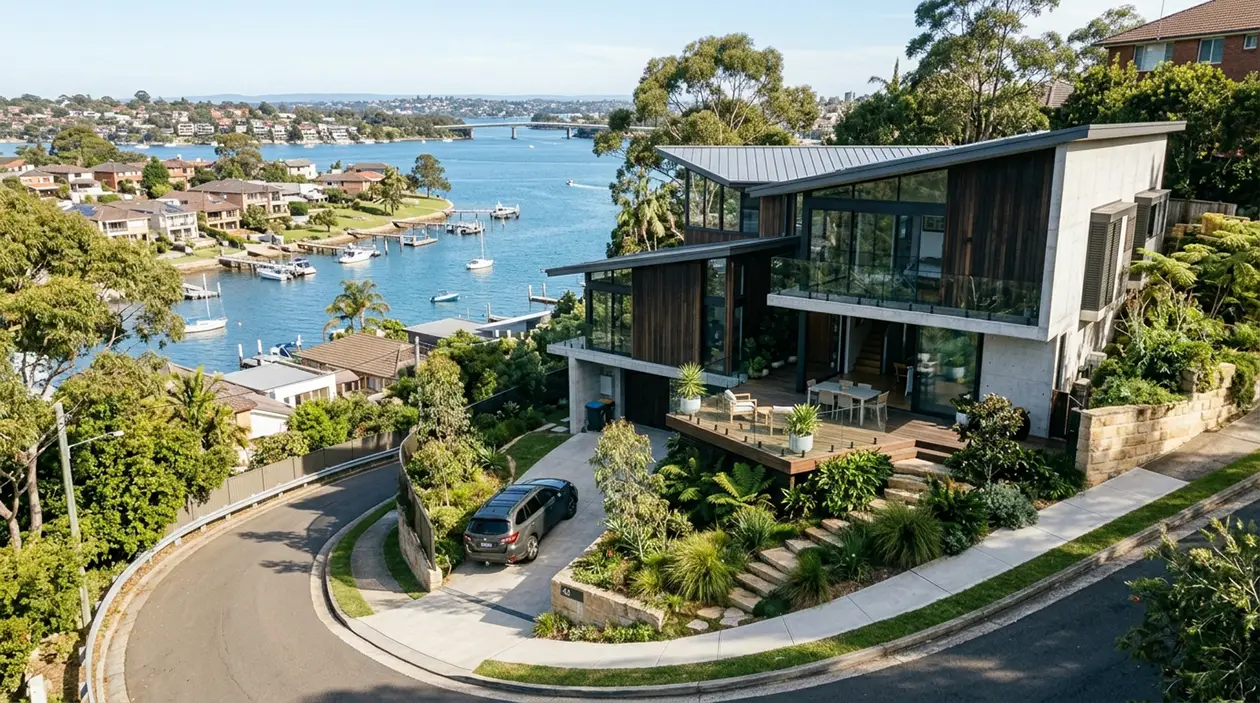
Sydney is full of sloping blocks. From the harbourside streets around Drummoyne and Russell Lea to the ridgelines through the Inner West and the steeper pockets further out, many of the city’s best building sites slope away from the road. The good news is that a sloping block is rarely a dealbreaker. The catch is that the wrong approach can quietly add tens of thousands of dollars to your site costs before a single wall goes up.
This guide is built as a sloping block feasibility and cost control toolkit. More than half of what follows is made up of assessment tables, checklists, and decision frameworks you can use to weigh up your own block, rather than dense theory. As a family-owned custom home builder led by licensed builder Jonathan Jamu (Builders Licence 359604C), we have spent two generations working with Sydney’s awkward sites, and the patterns below are the ones that consistently separate a smooth, fixed-price build from a budget blowout.
The short answer: Building on a sloping block in Sydney generally costs more than building on a flat block, with extra site costs typically ranging from $15,000 to $50,000 or more depending on the gradient. You keep those costs under control by working with the land rather than against it. Split-level designs, suspended (pole or pier) foundations, and minimal cut and fill reduce the most expensive parts of a sloping build, which are excavation, soil removal, and retaining walls. Done well, a sloping block also captures the views and natural light that lift the value of the finished home.
How steep a slope can you build on?
You can build on almost any slope, including a block falling at 30 degrees, provided you use the right foundation and engineering. As a rule of thumb, slopes up to 10 degrees are mild, 11 to 20 degrees are moderate, and anything over 20 degrees is steep and calls for specialist engineering and a custom design.
The single most useful thing you can do early is work out your block’s gradient, because the gradient dictates the foundation, the foundation dictates the site costs, and the site costs decide whether your budget is realistic. The gradient also shapes how much it will cost overall, so it pairs closely with understanding what it costs to build a custom home in Sydney. Use the matrix below to self-assess where your block sits.
The slope viability and foundation matrix
| Slope gradient | Recommended foundation | Typical extra site cost | What it means for your build |
|---|---|---|---|
| 0 to 3 degrees (flat) | Standard slab on ground | Minimal | Straightforward. Most builders, including volume builders, are suited to this. |
| 4 to 10 degrees (mild) | Stepped slab or minor cut and fill | Around $10,000 to $20,000 | Retaining walls are usually required and drainage planning becomes important. |
| 11 to 20 degrees (moderate) | Split-level design | Around $20,000 to $40,000 | The best results come from stepping the house down with the land to limit earthworks. |
| 21 to 30 degrees and beyond (steep) | Stilt, pole, or suspended slab | $50,000 and up | Standard slabs are not viable. You need a specialist sloping block builder and engineered footings. |
Try this now:
- Download a digital clinometer app (the Measure app on iPhone works well) and use it to find your block’s approximate slope in degrees.
- Check your contour survey, or order a detailed site survey, to find the exact rise over run (the fall across the block).
- If your slope is over 10 degrees, rule out standard slab-on-ground designs early. Forcing a flat-block design onto a sloping site is the fastest way to lose money on excavation.
What is the cheapest way to build on a slope?
The cheapest way to build on a slope is to build with the land, not against it. A suspended floor system (stumps, poles, or piers) removes the need for heavy earthworks, large retaining walls, and exporting soil from site, which are the three most expensive parts of a sloping build. Designing the home to step down the natural fall does the rest.
The five-step cost-saving checklist
- Eliminate cut and fill where you can. Ask your designer to suspend the floor on timber or steel stumps rather than excavating a flat pad. Excavation and soil removal are billed by the truckload, and a steep site can generate a lot of truckloads.
- Minimise retaining walls. Keep excavation depths shallow. As a guide, retaining walls beyond around 600mm in NSW generally trigger engineering and council approval, which adds cost and time. Three short terraced walls are often cheaper and more usable than one tall structural wall.
- Choose lightweight cladding. Swapping heavy brickwork for lightweight materials such as weatherboard, Colorbond, or Hebel reduces the load on your foundations, which matters far more on a hillside than on flat ground.
- Use a split-level floor plan. Break the home into zones that step down the slope naturally. This keeps the structure close to the existing ground line and avoids fighting the fall.
- Keep the driveway short. Position the garage as close to the street as the rules allow. Long driveways down a slope need engineering, retaining, and drainage, and they add up quickly.
Reality check: can you build a custom home for $300,000 on a slope?
It is extremely challenging. To get close to that figure on a sloping site you would generally need to limit the floor plan to under 120 square metres (two to three bedrooms), use a fully suspended timber or steel subfloor with no excavation, use lightweight cladding throughout, and build on a slope of less than 15 degrees. For most Sydney families, a realistic sloping block budget sits well above this once site costs, council requirements, and finishes are accounted for. We would rather give you honest numbers up front in a fixed-price contract than surprise you with provisional sums later.
The most common and most expensive mistake is forcing a volume builder’s flat-block design onto a sloping block. The design itself looks cheaper on paper, but levelling the site to suit it can waste tens of thousands of dollars on excavation and retaining walls that a purpose-designed home would never have needed.
What is the best foundation for a sloped lot?
A pier and beam (stilt or pole) foundation is usually the best structural and financial choice for slopes over 15 degrees, because it bridges the fall without major earthworks. A stepped concrete slab suits milder slopes under 10 degrees, while a split-level concrete design is the middle ground for moderate falls. The framework below compares the three.
The foundation decision framework
| Criteria | Stepped slab (cut and fill) | Split-level concrete | Pier and beam (stilts or poles) |
|---|---|---|---|
| Best for | Mild slopes under 10 degrees | Moderate slopes of 10 to 15 degrees | Steep slopes of 15 to 30 degrees and beyond |
| Excavation cost | High | Medium | Very low |
| Retaining walls | Extensive required | Moderate required | Rarely required |
| Water drainage | Prone to pooling, needs ag lines | Moderate management | Excellent natural flow |
| Verdict | Best for budget builds on gentle falls | Best for maintaining thermal mass | The strongest choice for protecting your budget on steep blocks |
The decision flowchart
- Is your slope over 15 degrees? If yes, use pier and beam.
- Is your slope under 15 degrees? If yes, move to the next question.
- Do you want masonry (brick) external walls? If yes, lean towards a stepped slab. If no, a split-level design will usually be more economical.
Volume builders versus specialist sloping block builders
Most volume builders can build on a mildly sloping block, usually up to around two or three metres of fall, but they tend to do it by performing large cut and fill earthworks to create a flat pad for one of their standard designs. That flat pad is where the hidden site costs live, and they often arrive as provisional sums after you have signed.
A specialist designs the home to the land instead, which is where the savings come from. Before you sign a preliminary agreement with any builder for a sloping block, put these four questions to them.
The builder vetting checklist
- “Do you modify your foundations to suit the land, or do you excavate the land to suit your standard slab?” If they only build slabs on flat pads, a steep block is the wrong job for them.
- “Are retaining walls included in my fixed-price contract, or are they a provisional sum?” Provisional sums on a sloping block are where budgets quietly blow out.
- “Will you give me a fixed site-cost guarantee before I pay my full deposit?” A builder who knows sloping blocks can commit to site costs early.
- “Can you show me three split-level or pole homes you have completed?” Photos of finished work on real slopes tell you more than any brochure.
Key takeaway: Volume builders look cheaper on paper for the house itself, but a specialist sloping block builder often works out cheaper overall, because the home is designed to remove the $50,000 or more of unnecessary earthworks and retaining that a standard design would have forced onto your site.
What decreases property value on a sloping block, and how do you avoid it?
The biggest detractors of value on a sloping block are poor drainage and large, dominating retaining walls that swallow usable yard space. Both are the result of fighting the slope instead of designing for it, and both are avoidable.
- Poor drainage. If water runs down the hill and pools against a cut-and-fill slab, it causes dampness and structural risk, which immediately devalues the home. Good design directs water around and away from the building. On a suspended floor the same water sits under the house instead, which is why subfloor ventilation and ground clearance matter more on a slope than on flat ground.
- The bunker effect. Digging deep into the hill blocks natural light on the lower floor and leaves rooms feeling like basements. Elevating the home avoids this and lets the design capture the view.
To protect and build value on a sloping block:
- Elevate, do not excavate. Building up captures the main advantage of a sloping block, which is the outlook. Homes with uninterrupted views sell at a premium across Sydney.
- Create usable tiers. Instead of one imposing three-metre retaining wall, build a series of shorter terraced walls. This turns the fall into flat, usable garden tiers that buyers and families value.
Sloping blocks and NSW council approvals
Sloping sites carry a few approval considerations that flat blocks rarely do, and getting across them early prevents delays.
- DA versus CDC. Complying development (the fast-track CDC path) limits how much you can cut and fill, generally to one metre each from natural ground level. Steeper blocks usually exceed that, which means a full Development Application through council rather than a fast-tracked certificate.
- Geotechnical and soil reports. Sloping and filled sites are commonly classified as problem (Class P) sites under AS 2870, which means engineered footings and a geotechnical report to confirm what the ground can carry.
- Retaining walls. Walls beyond a modest height (often around 600mm) generally need engineering and approval, and may need to be shown on your stormwater and drainage plans. Your certifier or council can confirm the threshold for your site.
- Drainage and stormwater. Councils want to see how water moves across a sloping block. A stormwater concept plan, subsoil (ag) drainage, and sometimes an on-site detention system are common requirements.
If your block also sits in a bushfire-prone area, which many elevated Sydney sites do, a Bushfire Attack Level (BAL) assessment will apply on top of the above. We manage all of this in house so you deal with one point of contact rather than juggling consultants. For the wider planning picture, our guide to land zoning in NSW explains how your zone shapes what you can build, and our overview of council approvals walks through the approval pathways in more detail.
Why homeowners choose Jonathan Homes for sloping blocks
Sloping sites reward builders who design for the land, and that is exactly how we work. Every Jonathan Homes project is personally managed by Jonathan from the first site walk-through to handover, so the person assessing your slope is the same person who builds on it. Our custom home design process uses in-house 3D design to model the home against your contours before construction begins, which is how we lock in a fixed-price contract with a guaranteed timeline rather than leaning on provisional sums.
As a Master Builders Association member with a 7-year structural warranty that exceeds the industry standard, an NDIS certified provider, and a Local Business Award finalist with a 5.0-star Google rating across 27 reviews, we bring genuine engineering experience to Sydney’s trickier blocks. Whether you are planning a split-level home in the Inner West or weighing up a double-storey design that steps with the slope, we can tell you honestly what your site will cost to build on.
If you are looking for a custom home builder in Sydney who understands sloping blocks, call Jonathan on 0414 595 933 for a free consultation, and bring your contour survey or site address so we can give you real numbers from the first conversation.