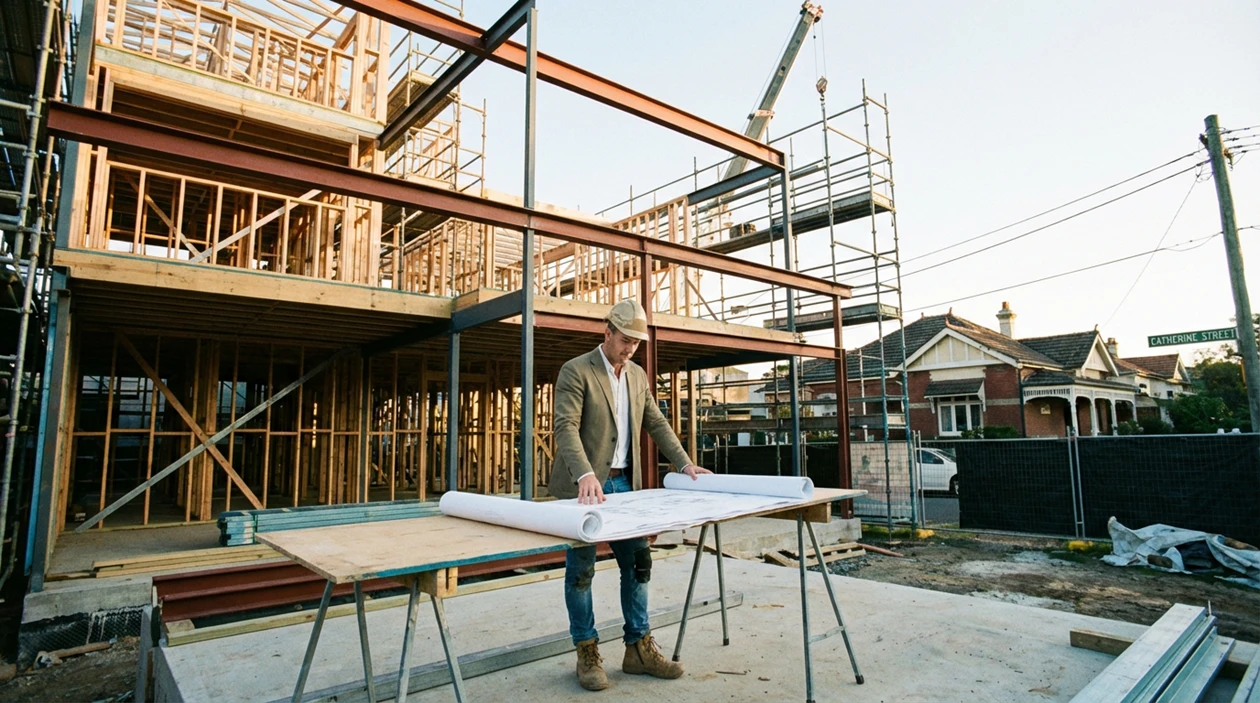
A custom home builder acts as your project’s CEO. They manage the 500-plus decisions, 20-plus trade teams, and layers of legal regulations required to build a one-of-a-kind house from the ground up. Unlike volume builders who sell a product off a plan, custom builders sell a service: distinct architectural design tailored to your block, site-specific engineering, and complete construction project management from first sketch to final handover.
Most people think builders just hammer nails. In reality, hammering accounts for less than five per cent of what a custom home builder actually does. Here is the exact breakdown of where your money goes — and why understanding the role puts you in the strongest possible position as a Sydney homeowner.
How Is a Custom Builder Different From a Volume Builder?
The fundamental difference is in what you are purchasing. A volume builder sells a house — a pre-designed product with standardised plans, fixed options, and economies of scale. A custom home builder sells a service — the expertise to design and construct something engineered specifically for your site, your family, and your long-term goals.
That distinction shapes everything: how the custom home design process works, what your builder’s daily responsibilities look like, how decisions are made, and what you should expect from the relationship. It also explains why the builder’s role on a custom home is so much broader than most homeowners realise.
What Your Builder Is Actually Doing When You Visit the Site and See No One There
This is the section that solves the anxiety almost every custom home owner experiences at some point during their build. You drive past your site on a Tuesday afternoon. No tradies. No noise. Nothing visible has changed since last week. You start wondering what you are paying for.
Here is what your builder is actually doing.
Before Construction Begins
Before a single shovel hits dirt, your custom home builder has coordinated and managed a body of work that most homeowners never see.
Design management and coordination
Your builder works alongside your architect or building designer to ensure the design is not just beautiful but buildable. This means reviewing plans for constructability, identifying potential cost traps before they are locked into the documentation, advising on material selections that balance aesthetics with longevity, and ensuring every specification can actually be sourced and installed within the construction programme. A builder who is involved from the design phase saves you money. A builder who receives finished drawings and has to price them after the fact almost always delivers bad news. This is especially true for the kitchen, where layout, materials and budget are deeply interconnected, our guide to kitchen design for your home breaks down how those decisions fit together.
Site investigation and analysis
Your builder commissions and reviews the technical reports that determine how your home will be built. Geotechnical reports reveal soil conditions and bearing capacity, which dictate footing design. Contour surveys map the exact levels of your block, which affects drainage, retaining walls, and floor heights. Service location plans identify where existing water, sewer, gas, electrical, and telecommunications infrastructure crosses your property. Arborist assessments determine whether trees can be removed or must be protected. Each of these reports feeds into the engineering design of your home, and your builder is the person who synthesises them into a construction methodology.
Engineering coordination
Your builder works with structural engineers to translate the architectural design into a structure that will stand up, comply with the National Construction Code, and meet relevant Australian Standards. This includes footing design based on your specific soil classification, structural steel specifications for spans and load paths, bracing requirements for wind and earthquake resistance, and connection details for every joint in the frame. For complex custom homes in Sydney — particularly on sloping sites, near waterways, or in bushfire-prone areas — the engineering coordination alone can take weeks of active collaboration.
Council and regulatory navigation
Your builder manages the interface between your project and the regulatory framework. This includes coordinating with town planners, lodging documentation with your local Sydney council or a private certifier, responding to requests for additional information, and ensuring every element of the design complies with the Local Environmental Plan, Development Control Plan, BASIX energy requirements, and the National Construction Code. Your builder does not replace the role of a certifier or planner, but they are the person who makes sure every moving part arrives at the right desk at the right time.
Trade procurement and contracting
For a typical custom home in Sydney, your builder sources, vets, and locks in contracts with 20 to 25 separate trade teams: concreters, formworkers, steel fixers, framers, plumbers, electricians, air conditioning installers, plasterers, renderers, tilers, waterproofers, roofers, glaziers, joiners, painters, landscapers, and more. Each trade has different lead times, availability windows, and quality standards. Your builder’s trade network — and their ability to attract and retain quality tradespeople — is one of the most valuable assets they bring to your project. It is also one of the hardest things for a homeowner to replicate independently.
During Construction
Trade scheduling and sequencing
This is the single most complex logistical task your builder manages, and the one that separates competent builders from the rest. Think of it as a dependency chain where every link relies on the one before it. Your plumber cannot rough-in until the frame is complete and inspected. Your plasterer cannot start until the plumber, electrician, and air conditioning installer have all finished their rough-ins and had them signed off. Your tiler cannot begin until waterproofing has been applied, cured, and independently certified. Your painter needs the plasterer, the joiner, and the tiler to be finished in that specific area first.
One trade running two days late can cascade through the entire programme. Your builder’s job is to manage that cascade — reshuffling schedules, bringing forward work that can proceed in other areas of the house, and maintaining momentum across 20-plus teams who are all juggling multiple projects simultaneously.
Quality control at every critical stage
Your builder inspects work before it gets covered up. This is non-negotiable on a quality custom build. Waterproofing membranes are inspected and photographed before tiles go on top of them. Framing is checked for accuracy, straightness, and compliance before plasterboard conceals it. Pipework and electrical wiring are inspected before concrete is poured or walls are closed in. Reinforcement steel is checked for correct size, spacing, and cover before the slab is poured.
These inspections protect you from defects that would be invisible after the fact and extremely expensive to rectify. A waterproofing failure discovered after tiling can cost $15,000 to $25,000 to fix. The same failure caught during inspection costs nothing to rectify. Your builder’s inspection regime is one of the most valuable things you are paying for.
Supply chain management
Your builder orders materials weeks or months in advance, tracks deliveries across dozens of suppliers, manages backorders and substitutions, and solves the inevitable problems when a specified product is discontinued, delayed, or arrives damaged. In Sydney’s current construction market, material lead times are a constant variable. Engineered stone benchtops might be eight weeks. Custom joinery could be twelve. Specific window profiles might be sixteen. Your builder maintains a procurement schedule that runs in parallel with the construction programme, ensuring materials arrive on site when the trade that needs them is ready to install them — not before (when they get damaged sitting on site) and not after (when the trade has moved on to another job).
Problem-solving and site decisions
Every custom home encounters surprises during construction. Existing services are not where the plans said they would be. Rock is discovered where the geotech report indicated clay. A structural beam does not align perfectly with the architectural intent. A specified product is discontinued mid-build. Your builder makes dozens of these decisions every week — assessing options, consulting engineers or architects when needed, calculating cost implications, and presenting solutions to you. The speed and quality of this problem-solving directly affects your timeline, your budget, and the final quality of your home.
After Handover
Defect liability management
Under NSW building legislation, your builder is responsible for rectifying defects for a statutory period after handover. A quality custom builder does not wait for you to find problems. They conduct their own post-handover inspections at 30, 90, and 365 days, proactively identifying and rectifying items before they become complaints. This ongoing accountability is part of what you are paying for when you engage a custom builder rather than managing trades yourself.
Warranty coordination
Your home contains products from dozens of manufacturers, each with their own warranty terms and conditions. Your builder maintains records of every product installed — model numbers, batch numbers, installation dates, and warranty documentation — and coordinates warranty claims on your behalf when needed. This documentation package, handed over at practical completion, is a valuable asset that protects you for years after construction is finished.
Where Your Builder’s Time Actually Goes
If you mapped a custom home builder’s working week during an active construction phase, here is roughly how it breaks down:
Around 30 per cent is spent on physical site presence — supervising work, conducting inspections, meeting with trades, resolving on-site issues, and checking quality at every stage.
Around 40 per cent goes to logistics, administration, and coordination — scheduling trades, managing procurement, processing variations, updating construction programmes, liaising with engineers and certifiers, managing compliance documentation, and handling the financial administration of the project.
The remaining 30 per cent is client communication, design coordination, and problem-solving — answering your questions, presenting options when decisions are needed, coordinating with architects on design details, and working through the inevitable challenges that every custom build presents.
The construction work you see on site is the visible tip of an iceberg. The invisible work underneath is what determines whether your custom home is delivered on time, on budget, and to the standard you are paying for.
How Your Builder Fits Into the Design Team
There is a common misconception that the architect designs the house and the builder just builds it. In practice, the relationship is far more integrated than that — and on a custom home, it needs to be.
Your architect or building designer brings spatial design expertise, aesthetic vision, and the ability to translate your lifestyle into floor plans and elevations. Your builder brings construction knowledge, cost awareness, trade network access, and an understanding of what is practically achievable within your budget and timeframe.
The best outcomes happen when these two disciplines collaborate from the earliest stages of design. A builder involved during the design phase can flag cost implications before they are locked into the drawings, suggest construction methodologies that achieve the same design intent more efficiently, identify materials that deliver better value without compromising quality, and ensure the design accounts for Sydney-specific factors like soil conditions, bushfire ratings, flood overlays, and council-specific planning controls.
When a builder is brought in only after the design is finished, the first conversation is often about what needs to change to fit the budget. When a builder is involved from the start, the design evolves within the budget from the beginning. That distinction can save tens of thousands of dollars and months of redesign.
This collaborative approach is central to how we work at Jonathan Homes. Jonathan is involved from the first design conversation through to final handover, which means construction knowledge informs every design decision — not just the ones made after the drawings are finished.
The Build Follows a Defined Sequence
Every custom home moves through a series of defined stages — from initial feasibility through design, approvals, base works, framing, lock-up, fit-off, and handover. Understanding where you sit in that sequence, and what decisions are required from you at each milestone, is the single most practical thing you can do to keep your build running smoothly.
When a builder is brought in only after the design is finished, the first conversation is often about what needs to change to fit the budget. When a builder is involved from the start, the design evolves within the budget from the beginning. That distinction can save tens of thousands of dollars and months of redesign.
This collaborative approach is central to how we work at Jonathan Homes. Jonathan is involved from the first design conversation through to final handover, which means construction knowledge informs every design decision — not just the ones made after the drawings are finished.
Why Communication Is Your Most Valuable Tool
The number one cause of construction delays is not weather. It is client indecision. Every day a decision is delayed creates a ripple effect through the construction schedule. Your builder cannot order materials without confirmed selections. Trades cannot be scheduled without confirmed scopes. And once a trade team moves to another job because yours was not ready, getting them back can take weeks.
The most successful custom home builds share a common trait: clear, documented, timely communication between the homeowner and builder. Put every request in writing. Respond to selection deadlines promptly. Ask questions early rather than raising concerns late. And understand the formal variation process before you need to use it.
The Bottom Line
A custom home builder does far more than manage construction. They are the single point of accountability for turning your vision into a physical house — navigating design complexity, regulatory compliance, trade coordination, supply chain logistics, quality assurance, and budget management simultaneously.
The best thing you can do as a Sydney homeowner is understand the role, choose the right builder for your project, and communicate clearly. The more informed you are, the better your build will be — and the more value your builder can deliver.
Ready to talk about your project? Get in touch with Jonathan Homes to discuss what a custom build looks like for your site and your goals.