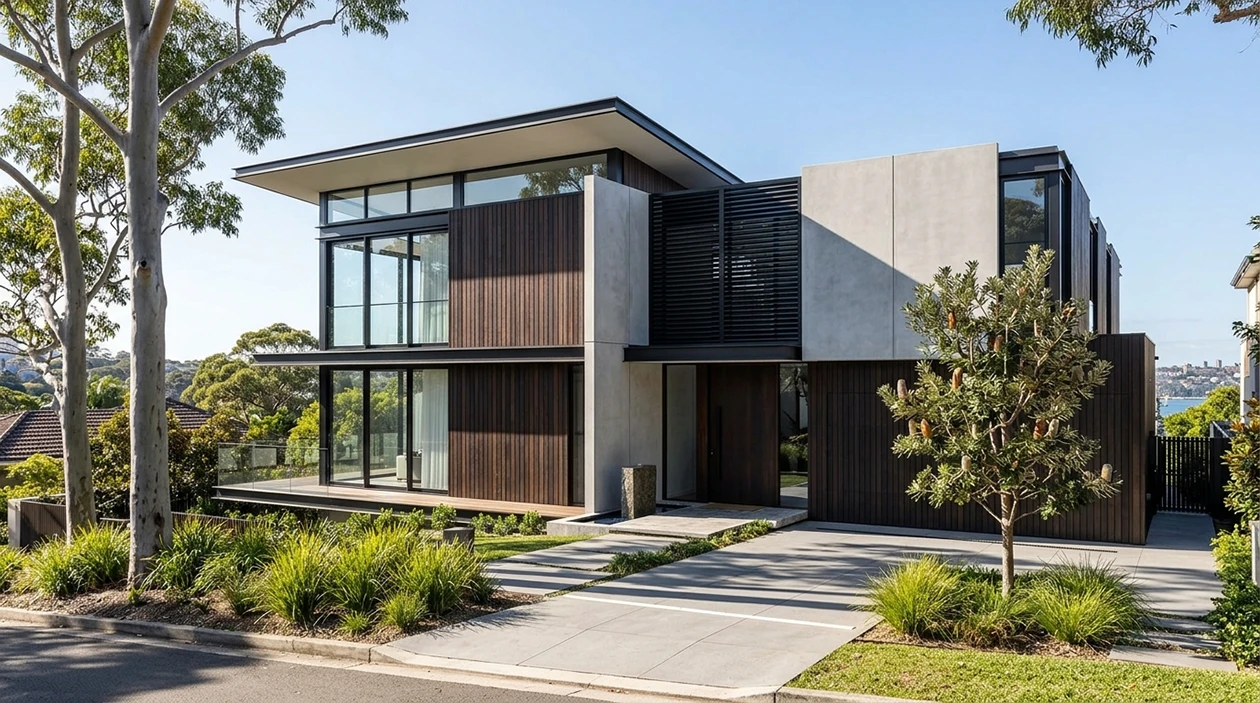
A house facade is the front exterior wall and overall architectural presentation of a home. It’s the street-facing skin that does the heavy lifting on kerb appeal, resale value, weather protection, and streetscape integration. In Sydney, a facade that performs has to balance architectural style with strict NSW council rules, BASIX energy compliance, and the particular punishment our climate hands out: westerly afternoon sun, salt-laden easterlies along the coast, and the occasional bushfire exposure overlay.
After two generations of Sydney builds across the Inner West and beyond, our team at Jonathan Homes has watched facades age well and age badly. The difference almost never comes down to the style chosen. It comes down to whether the design respected the block, the materials suited the local conditions, and the proportions held up at street level. This guide walks through how to choose a facade that lasts, covering block matching and council approvals through to material palettes, budget allocation, and a four-week cosmetic facelift plan if you’re working with an existing home.
How do I choose the right facade for my block and layout?
The best facade for your home is one that accommodates your block’s topography, meets local council setbacks, and visually previews your interior design. Let the block shape dictate the architecture, not the other way around. If you’re planning open-plan living through the interior, your facade decisions about window placement, ceiling height and entry sightlines need to align with that interior continuity from the outset.
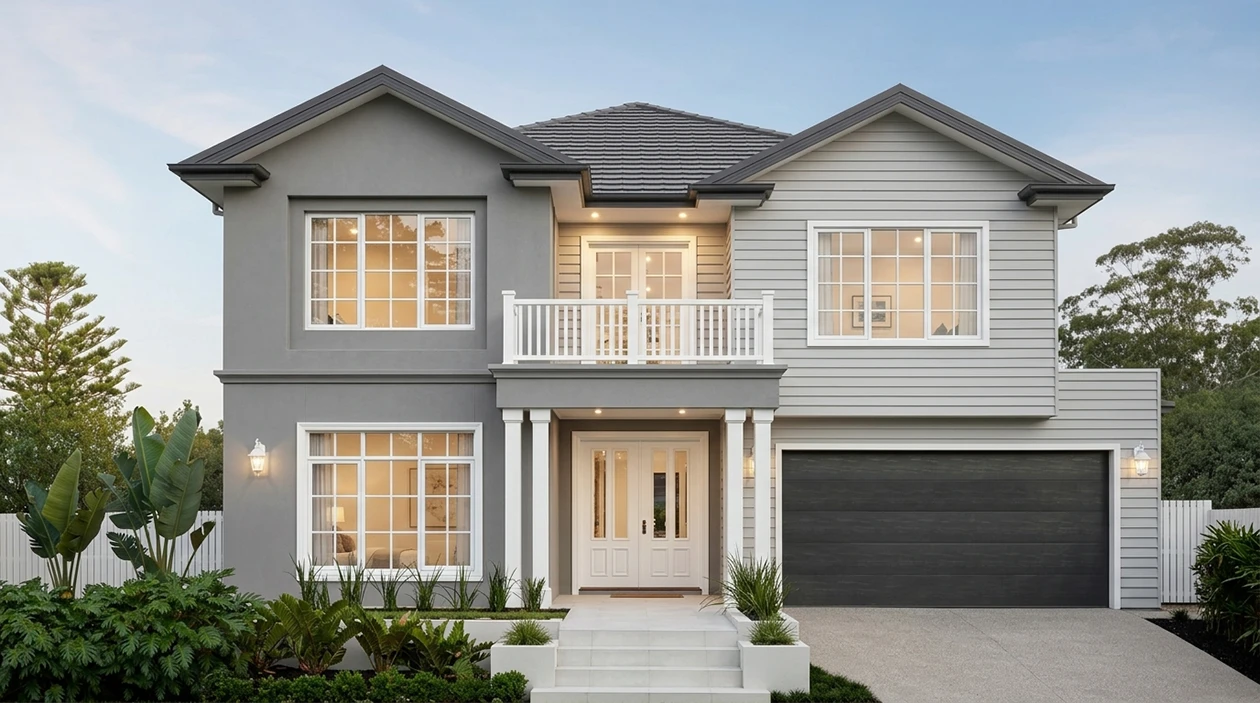
There’s a temptation, especially when a homeowner has fallen in love with a facade style from Pinterest or a magazine, to force that look onto a block that won’t take it. A double-storey Hamptons facade with a hipped roof needs frontage to breathe (typically 12 metres or wider). Push it onto a 9-metre Sydney battle-axe lot and the proportions collapse: the eaves crowd the boundary, the window placements feel cramped, and the streetscape contribution evaporates. The smarter move is to match the facade style to the block.
Block and style matching framework
| Block Type | Best-Suited Facade Style | Why It Works |
|---|---|---|
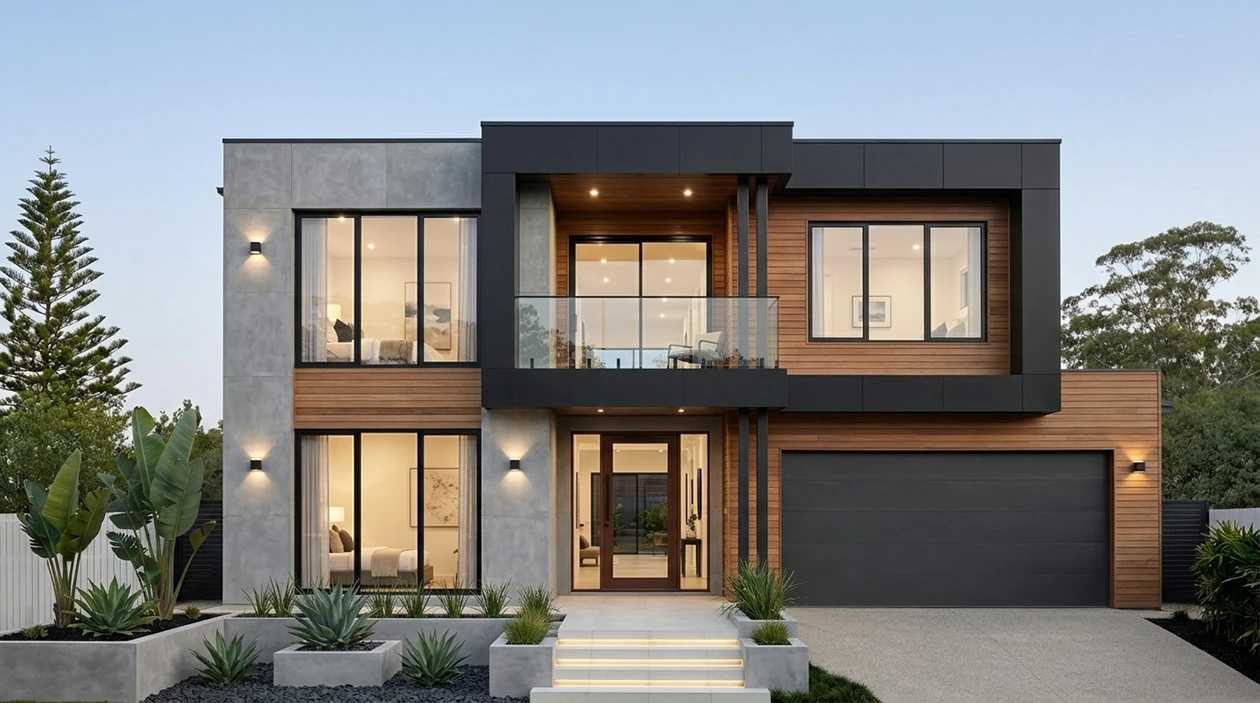
| Narrow blocks (under 12m wide) | Contemporary or Modern | Vertical proportions and parapet walls visually maximise width without crowding setbacks |
| Sloping blocks | Split-level Mid-Century or Modern Queenslander | Utilises under-house space; lightweight cladding lowers structural costs and works with the gradient |
| Coastal locations | Hamptons or Australian Coastal | Weatherboard cladding suits salt exposure; wide eaves manage glare and rain |
| Standard 600m² Inner West lot | Contemporary, Hamptons or French Provincial | Frontage typically allows symmetry; streetscape harmony is usually achievable |
| Heritage Conservation Area lot | Match dominant neighbourhood style | Council will scrutinise material, roof pitch and fenestration; deviation risks DA refusal |
| Acreage or wide rural-style block | Modern Queenslander or Hamptons | Block scale absorbs deeper verandahs and articulated rooflines without looking ostentatious |
Decision flowchart
A quick three-step check before you commit to a facade direction:
- Is your block inside a Heritage Conservation Area? If yes, match the dominant neighbourhood character (roof pitch, window proportions, materials). If no, proceed to step two.
- Is your block less than 12 metres wide? If yes, lean toward vertical-emphasis Contemporary or Modern styles with parapet walls. If no, proceed to step three.
- What’s the dominant westerly exposure? If your front faces west, prioritise deep eaves, recessed windows, or a verandah element regardless of style. Sydney’s afternoon sun is the single biggest cause of facade fade and interior glare.
Immediate action items
Before you brief a builder or draftsperson, pull two pieces of information together:
- Your site survey confirming exact block frontage width, depth, and slope gradient.
- A streetscape audit: drive your specific street and photograph the dominant roof pitches (hip, gable, skillion) and material patterns. This is the cheapest streetscape harmony check you’ll do.
Do I need council approval to change my facade?
Yes. Any significant facade change in NSW requires either a Complying Development Certificate (CDC) under State Environmental Planning Policy or a full Development Application (DA) through your local council. Your design also has to legally comply with BASIX for thermal performance and your BAL rating for bushfire resistance, both of which will narrow your material choices before you’ve even submitted plans.
This is the section that catches most homeowners off guard. The compliance path is determined long before you choose between weatherboard and render, and getting it wrong costs months and tens of thousands of dollars in re-design. We cover the broader DA vs CDC approval pathway for Sydney home renovations in detail; what follows here is the facade-specific subset.
NSW facade pre-submission compliance checklist
| Step | What to Check | Why It Matters | Tool or Reference |
|---|---|---|---|
| 1 | Zoning and HCA status | Determines whether your property sits in a Heritage Conservation Area or has a heritage item listing | NSW Planning Portal (planningportal.nsw.gov.au) |
| 2 | BAL rating | Bushfire Attack Level of your site, which restricts facade materials in bushfire-prone areas | NSW RFS BAL mapping (rfs.nsw.gov.au) |
| 3 | BASIX assessment | Thermal performance prediction based on window-to-wall ratio, glazing type, orientation, and insulation | BASIX online tool |
| 4 | NCC compliance | National Construction Code Volume Two, which covers structural, fire, energy, and weatherproofing for Class 1 dwellings | NCC 2022 (abcb.gov.au) |
| 5 | Approval pathway | Whether the change qualifies as Exempt Development, CDC, or full DA | LEP and SEPP (Exempt and Complying Development Codes) 2008 |
What BAL ratings actually mean for your facade
If your site is rated BAL-12.5 to BAL-40, several common Sydney facade materials drop off the table or require specific upgrades. Standard timber battens (currently one of the most popular contemporary facade elements) are not compliant in BAL-29 and above without significant treatment or substitution. The workaround is fibre cement battens or aluminium wood-look battens, which read almost identically from the street but pass AS 3959 requirements.
| BAL Rating | Risk Level | Facade Material Implication |
|---|---|---|
| BAL-Low | Insufficient to warrant requirements | Standard materials acceptable |
| BAL-12.5 | Ember attack | Non-combustible cladding preferred; gaps under eaves sealed |
| BAL-19 | Ember and radiant heat | Toughened glazing on west and north elevations; fibre cement preferred over timber |
| BAL-29 | Higher radiant heat | Timber battens not compliant without certified treatment |
| BAL-40 | Direct flame contact possible | Masonry, fibre cement or steel; restricted glazing |
| BAL-FZ | Flame Zone | Specialist construction; most retail materials non-compliant |
Common BASIX mistakes that cost money
The most expensive BASIX failures we see on Sydney builds are aesthetic-first, compliance-second decisions:
- Dark roof colour on a high-exposure site. Monument black or charcoal roofs absorb significantly more heat than light tones, often failing BASIX unless paired with upgraded insulation or solar offsets.
- Large western-facing glazing without shading. A four-metre glass slider facing the afternoon sun looks brilliant in renders and fails BASIX unless you specify low-E or low-SHGC glass plus deep eaves or external louvres.
- Window-to-wall ratio creep. Architects and homeowners both gravitate toward more glass. Past roughly 25 per cent of wall area, BASIX gets very fussy about everything else in your spec.
Self-check before sending to a draftsperson
Can you confidently tick all four of these?
- Zoning and HCA status confirmed via the NSW Planning Portal
- BAL rating identified and material implications understood
- Preliminary window-to-wall ratio under 25 per cent, or compensating measures specified
- Approval pathway decided (Exempt, CDC or DA)
If any of these are unclear, the conversation belongs with your builder before the architect, not the other way around. Builder-led compliance review at concept stage saves DA cycles.
What materials should I use for a Sydney facade?
The most durable facade materials for Sydney conditions are pre-finished fibre cement cladding, face brick, and rendered masonry. The most balanced architectural result comes from mixing three materials in a 60/30/10 proportion: a heavy primary base, a lightweight secondary, and a textural accent. That’s the recipe that gives a facade depth without looking busy.
The Rule of Three: 60/30/10 material formula
This isn’t a hard rule. It’s a starting point that prevents the two most common facade failures. Mono-material facades (100 per cent brick, 100 per cent render) look flat and date quickly. Five-material facades look chaotic from the street and never feel resolved. The 60/30/10 framework forces a hierarchy.
| Layer | Proportion | Role | Common Sydney Examples |
|---|---|---|---|
| Primary | 60% | The visual base and structural read of the facade | Face brick (Austral, PGH), acrylic or sand-and-cement render, full-height fibre cement |
| Secondary | 30% | The contrast layer that breaks up the primary mass | Linea weatherboard, James Hardie Stria cladding, painted weatherboard for Hamptons styles |
| Accent | 10% | The textural detail that does the heavy aesthetic lifting | Spotted gum timber battens, aluminium wood-look battens, stone cladding, dark powder-coated metal |
Material matrix: cost, maintenance and lifespan
Material decisions made on Pinterest don’t survive ten Sydney summers. The table below summarises what we’ve observed across our project portfolio and what manufacturers warrant.
| Material | Upfront Cost | Maintenance Cycle | Sydney Lifespan | Coastal Salt Performance |
|---|---|---|---|---|
| Face brick | Medium–high | Very low | 50+ years | Excellent |
| Acrylic render | Medium | Repaint 7–10 years | 25–30 years | Moderate (hairline cracking) |
| Fibre cement cladding | Medium | Repaint 12–15 years | 25+ years | Excellent |
| Linea weatherboard | Medium–high | Repaint 8–12 years | 25+ years | Excellent for coastal |
| Timber battens (Spotted Gum) | High | Oil every 12–18 months | 20–25 years | Poor (silvers fast) |
| Aluminium wood-look battens | High | Negligible | 25+ years | Excellent |
| Natural stone cladding | High | Negligible | 50+ years | Excellent |
| Painted weatherboard | Medium | Repaint 6–8 years | 20–25 years | Good |
Try this now: the seven-day sun test
Sydney sunlight is uncompromising on colour. The same brick or cladding sample that looked perfect in a showroom can read dramatically differently at street level on your site. Before locking in a material spec:
- Request physical samples from suppliers. Austral Bricks, PGH, James Hardie, and your local timber merchant will all provide them.
- Stand the samples outdoors in their intended orientation on your block, facing the direction they’ll actually sit (north-facing samples for north-facing facades).
- Leave them for at least seven full days. Photograph them at 8am, midday and 4pm.
- Compare. The brick that looked warm grey in the showroom often reads cool blue in afternoon Sydney light.
This is a 30-minute exercise that has saved more than one of our clients a $20,000 re-clad decision.
Are facade upgrades from a builder worth it?
Facade upgrades (the pre-priced aesthetic enhancements offered as add-ons to a base build) are worth it when they elevate the home from “standard” to “premium” within the suburb’s existing housing tier. Typical ROI on the right upgrades sits at 1.5x to 2x the upgrade cost at resale, but the wrong upgrades sit at near-zero. The difference is whether the upgrade affects the first 30 seconds of a buyer’s perception.
This is where homeowners over-spend most often. Builders will offer extensive upgrade packs: premium brick selections, additional roofline articulation, expanded portico designs, and stone feature pillars. They’re not equal in return.
Upgrade ROI evaluator
| Upgrade Category | Typical Cost | Resale ROI | Why |
|---|---|---|---|
| Window size increase (front facade) | $4k–$10k | High | Floods the entry with natural light, the single most impactful interior change visible from the street |
| Entry door widening (1200mm pivot) | $3k–$8k | High | Front door is the focal point in any photograph or inspection arrival |
| Eaves extension (300mm to 600mm) | $5k–$12k | High | Visible architectural depth; also improves BASIX and reduces facade weathering |
| Render upgrade over face brick | $10k–$20k | Medium–high | Significant style shift toward contemporary; suburb-dependent |
| Roof articulation (gable additions) | $8k–$18k | Medium | Adds character but only reads from certain angles |
| Stone cladding on side walls | $8k–$15k | Low | Money spent where no one sees it; only the street-facing section captures value |
| Decorative balcony detailing | $5k–$15k | Low | High maintenance, rarely a buyer priority |
| Premium garage door | $2k–$6k | Medium–high | Garage occupies up to 30% of a Sydney facade, giving it disproportionate visual impact |
The 3D render rule
If you take one piece of advice from this guide on a new build: pay for a proper 3D render before you sign the building contract.
In-house 3D design is something we run on every project we quote, and the reason is simple: a 3D render at concept stage typically costs $300 to $800, and it’s the only reliable way to catch proportion errors before construction begins. Once the slab is poured and BASIX is locked in, facade changes are eye-wateringly expensive. We’ve seen homeowners go to contract with elevation drawings only, then realise at frame stage that the garage dominates the streetscape or the front door is undersized for the entry porch. By then, structural changes are six-figure decisions.
The render isn’t a luxury. It’s the cheapest insurance policy on the project. For ballpark figures on broader custom home budgets in Sydney, see our Sydney custom home cost guide.
How do I update my facade without rebuilding?
You can dramatically improve a dated facade without structural rebuilding through four interventions: surface palette refresh, garage and front door modernisation, architectural detailing upgrades, and layered structural landscaping. Done together, these can transform an 80s or 90s Sydney facade in under a month without DA approval.
This is the work we recommend for clients who’ve bought a home with good bones but a tired streetscape, particularly common across the Inner West where heritage-era cottages and 70s–80s brick builds dominate. None of this requires major structural change; most falls under Exempt Development. For interior refresh that extends beyond the facade into kitchens, bathrooms and structural changes, see our home renovations service.
The four-week cosmetic facelift plan
| Week | Focus Area | Specific Actions | Cost Range |
|---|---|---|---|
| Week 1 | Paint and surface prep | High-pressure wash brickwork and render; treat efflorescence; for dated bricks (80s blonde, 70s orange), apply mineral silicate paint (not standard acrylic) | $3k–$8k |
| Week 2 | Garage and front door | Paint or replace garage door with timber-look sectional; replace front door with 1200mm pivot or restored heritage door | $4k–$12k |
| Week 3 | Architectural details | Custom blackened steel house numbers; warm 3000K LED facade sconces; rendered masonry or hardwood letterbox | $2k–$5k |
| Week 4 | Landscaping integration | Layered native planting to hide foundation line; structured low hedge; uplit specimen tree if frontage allows | $5k–$15k |
Why mineral silicate paint matters for old brick
Standard acrylic paint on a dated 80s blonde-brick facade is one of the most common Sydney mistakes. The paint film traps moisture and causes the bricks to spall behind the coating within five to eight years. If there is white powder on the brick before you start, treating efflorescence before you paint matters as much as the paint choice, because coating over an active deposit is what triggers the spalling. Mineral silicate paint (Keim is the benchmark) chemically bonds with the brick and allows vapour transmission, which means the brick continues to breathe. The product is more expensive per litre but lasts 15+ years and doesn’t damage the substrate.
Garage door: the highest-leverage single change
In our experience across Sydney projects, the garage door is the highest-leverage single change you can make to a dated facade. Modern double-garage doors typically occupy 25 to 30 per cent of the street-facing surface area. Replace a 90s flat-panel Colorbond garage door (repainted in a flat dark colour, or swapped out for a timber-look sectional) and the entire facade reads as a different decade, even before any other change.
Success metrics
Stand directly across the street from your home, mid-afternoon, and take a single photograph. Ask yourself:
- Is the front door the immediate focal point? If yes, the facelift has succeeded.
- Or is the garage still dominating the visual field? If yes, the garage door is the next intervention.
- Does the landscape hide the foundation line and integrate with the architecture? If not, week four needs revisiting.
A final note on facades that last
Two-thirds of the facades we’ve seen fail over twenty-plus years didn’t fail because of fashion. They failed because of compromise at the wrong moments. Cheap render painted with the wrong product. Brick selections made indoors under fluorescent lights. Timber battens specified for a coastal site that silvers within two summers. Skipping a 3D render to save $500 and committing to a $2.5 million home that doesn’t sit right at the street.
The Sydney facades that age beautifully aren’t necessarily the most expensive. They’re the ones where someone, whether the builder, the architect or the homeowner, paid attention to the block, respected the regulations, and made material decisions for the conditions rather than the catalogue.
As a family-owned custom home builder operating across Sydney with a Master Builders Association membership, NDIS certification, and a 7-year structural warranty that exceeds the NSW statutory minimum, we’ve built our reputation on getting these decisions right at the front end. If you’re planning a custom build, a knockdown rebuild, or a facade refresh anywhere in the Inner West or broader Sydney metro, call Jonathan on 0414 595 933 for a free consultation. Builders Licence 359604C.