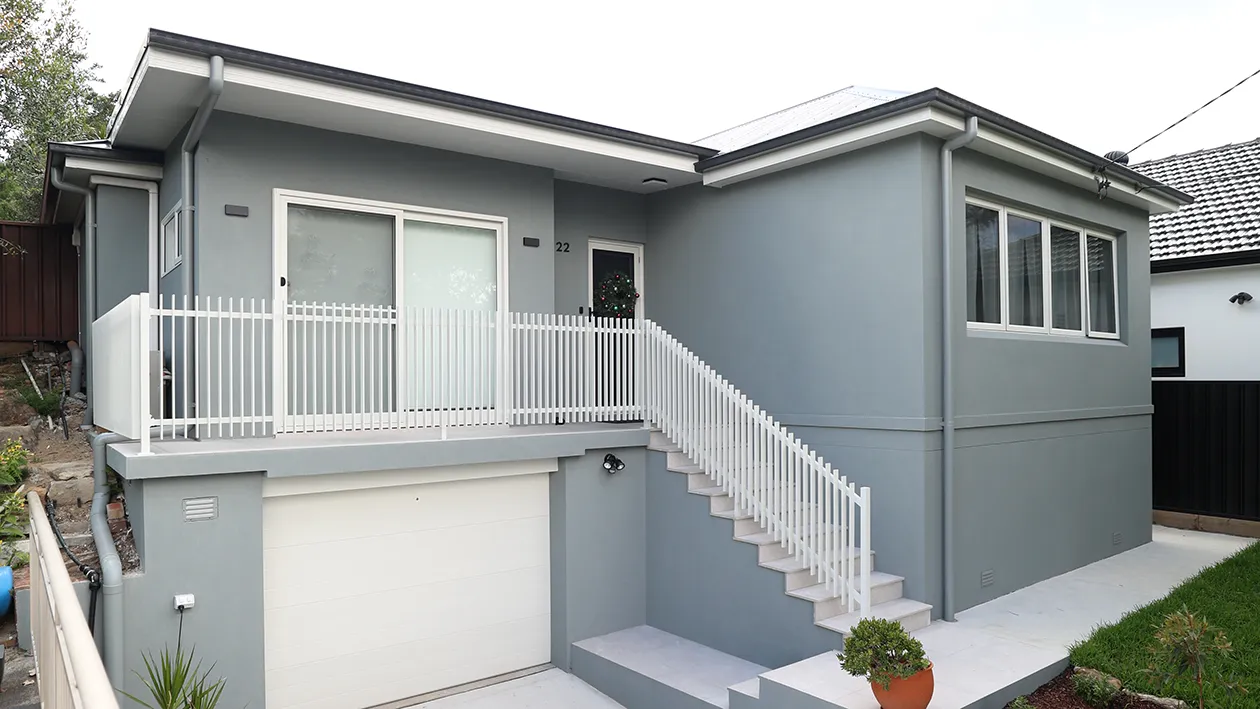
Renovating to sell is only worth it if you get $2 back for every $1 you spend. In the 2026 Sydney market, cosmetic updates deliver the strongest return: high contrast painting, fixing the structural red flags a building inspector will find anyway, and modernising fixtures. Major structural work done purely for resale is where most sellers overcapitalise.
Is It Worth Renovating to Sell? The 2026 ROI Assessment
Run the Rule of 2 before you commit. For every $1 you spend, you need to project $2 in added value. Anything less and you are funding the next owner’s upgrade.
The Rule of 2 assessment
Work out your ratio, then read it against this guide:
| Projected return | What it means | What to do |
|---|---|---|
| Under 1.5x | The market will not pay you back | Do not renovate. Clean, declutter and sell as-is |
| 1.5x to 2x | Marginal | Proceed carefully. Stick to DIY cosmetic fixes only |
| 2x or above | Green light | Professional cosmetic renovation is justified |
Your three step action plan
- Get three appraisals. Ask three local agents to value the home exactly as it stands today. Do not tidy up first. You want the honest number.
- Ask for the projected figure. Ask each agent what the property would fetch with cosmetic updates done: kitchen, bathroom, paint and floors. Agents see this every week in your suburb and their estimates are usually close.
- Do the subtraction. Take the as-is figure away from the projected figure. If the gap is $50,000, your absolute maximum renovation budget is $25,000. Not $40,000. Not “we will see how it goes.”
That third step is the one people skip, and it is the reason so many sellers finish a renovation with a beautiful kitchen and no profit. If you want a fuller method for setting the ceiling and holding to it, our guide on how to budget for a home renovation walks through contingency and staged payments.
A note on Sydney. Inner West stock is largely Federation and interwar, so the gap between as-is and renovated runs wide. Buyers are pricing in the hassle of doing it themselves. That is good news for sellers, but only if the work you do is the work buyers actually care about.
Where to Spend $20,000 Before You List
Sale prep works to a fixed ceiling, not an open budget. Once you have set that ceiling using the Rule of 2, the split that does the most work is street appeal, a kitchen and bathroom facelift, and lighting. Below is how a $20,000 ceiling divides.
This is a different exercise to renovating a home you plan to keep. Here you are not buying a better kitchen, you are buying a better first impression at an open home. If you are renovating to live in the house rather than to sell it, the maths changes completely, and our guide to home renovations that add real value breaks down return on investment by project type.
The $20,000 budget allocation template
Street appeal: $2,500
- High pressure wash the driveway, path and fencing
- Paint the front door in charcoal or navy
- Fresh mulch through the garden beds
- New modern house numbers and a new letterbox
The facelift kitchen: $6,000
- Respray the existing cabinet doors. Do not replace the carcasses
- New matte black or brushed brass handles
- Replace the tapware
- Composite stone overlay benchtop over the existing bench
That is deliberately the cheapest tier of kitchen work. For what a full replacement costs by scope, see our kitchen renovation cost guide.
The bathroom refresh: $4,500
- Regrout all tiles in white
- Replace the vanity and tapware
- Install a frameless shower screen
Anything beyond this, particularly moving fixtures or relaying the floor, moves you out of refresh territory and into a full bathroom renovation.
Paint and light: $7,000
- Fresh internal paint in warm whites throughout
- Replace dated oyster lights with LED downlights
- Add dimmers to living areas
These are planning figures, not a quote. Trade pricing moves. The condition of your home changes everything. The only way to know your number is a fixed price quote against a proper scope.
Try this now
Walk out to your kerb. Stand where a buyer would park. Take a photo of your house on your phone and look at the photo rather than the house. The first ugly thing you notice is the first thing to fix tomorrow.
Photos flatten everything. What you see is what the listing will look like. Usually the culprit is the front door, the gutters or the driveway.
The most common mistake
Overcapitalising by knocking down walls or moving plumbing. Relocate a bathroom or open a load bearing wall and you are into structural engineering, waterproofing and possibly council approval. The budget stops resembling the one you wrote down. Buyers rarely pay a premium that covers it. It is one of several renovation mistakes that quietly erode your return.
There is an important exception. If you are staying put for a few more years and the renovation is for your family as much as the sale, structural work can absolutely be the right call. The maths is completely different when you get to enjoy the result. That is a different project with a different brief, and worth talking through properly before you decide.
What Devalues a House the Most, and the Inspection Red Flags
Unapproved structural work, dampness and mould, and heavily personalised DIY renovations do the most damage to an Australian property’s sale price.
Buyers do not deduct politely. They send a building and pest inspector, and then they negotiate against the report. Every item on that report becomes a discount request.
The pre-inspection eradication checklist
Water and dampness (inspector red flag number one)
- Check under every sink for staining, swelling or a musty smell
- Look for bubbling or flaking paint on walls adjoining showers
- Clear all gutters and downpipes so water is not overflowing against the wall
- Check the base of shower screens and the grout in wet areas for movement
- Look for tide marks or salt deposits on brickwork near ground level
If any of these turn up something worse than surface staining, read our guide on how to identify structural damage in a house before you get quotes.
The DIY disaster
- Lift and remove poorly laid floating floors
- Repaint sloppy cut-in lines around cornices, skirtings and architraves
- Have any uncertified electrical work inspected and rectified by a licensed electrician
- Check that any past extension, deck or carport has approval documentation
Over-personalisation
- Paint over feature walls in strong colours
- Remove heavy or dark window drapery
- Consider filling in an above ground pool. Many buyers read it as a maintenance liability rather than an asset
Noisy floors belong on the same list. Buyers notice them walking through an open home, and inspectors note them in the report. Most are a cheap fix from above, and our guide on fixing squeaky floors without removing the flooring covers the method before you get quotes for anything larger.
How to clear unapproved works before you list
If a past owner enclosed a carport, added a deck or converted a garage without approval, you do not have to hand that problem to a buyer. NSW has a specific instrument for it: a Building Information Certificate, issued by your council under Division 6.7 of the Environmental Planning and Assessment Act 1979.
Once issued, it prevents that council from ordering the building be repaired, demolished, altered, added to or rebuilt, other than for fair wear and tear. That protection runs for seven years. In practice, it turns something a buyer’s solicitor would hammer you on into a piece of paper you hand over at exchange.
What it costs varies by council, because each sets its own schedule. Woollahra Council’s 2026-27 fees are a useful indication for a Sydney property: $530 for a house and its outbuildings, plus a $101.50 file retrieval fee, so about $631.50 as a minimum.
If the application covers unauthorised work, expect more. The council adds a fee equal to the maximum DA fee plus the maximum construction certificate fee, based on what the work was worth. A second inspection costs another $100. Check your own council’s published schedule before you budget.
Applications go through the NSW Planning Portal. You can lodge one yourself, or a purchaser under contract can, or a solicitor for either side.
You will generally need:
- Building plans
- A current identification survey from a registered surveyor
- A report from a suitably qualified professional referencing the National Construction Code and the relevant Australian Standards
The certificate has limits. It does not cover swimming pool safety fencing, which sits under the Swimming Pools Act 1992, and it will not stop a fire safety order or a building product rectification order.
Start this early. A survey and a professional report take time to arrange, and this is not something you want running in parallel with an exchange. If you are planning further work before listing, our guide to council approvals for home renovations in NSW covers what needs consent and what does not.
The self-check method that pays for itself
Spend around $400 on your own independent building and pest inspection before you list.
You will receive, in writing, the exact list of items every buyer’s inspector is going to find. You then get to choose: fix it quietly for a few hundred dollars, or hand a buyer a negotiating lever worth several thousand. In our experience on Inner West properties, unapproved works and moisture in wet areas are the two findings that cost sellers the most at the negotiating table.
What Colour Makes a House Look Expensive in 2026?
Warm creamy whites inside, paired with high contrast dark accents outside. That combination reads as architectural and current, and it photographs beautifully, which matters more than ever when most buyers see your home on a phone screen first.
The expensive palette
Interior walls: Dulux Natural White or Taubmans Cotton Ball. Both reflect light without going cold, and they make rooms feel larger. Avoid stark bright whites on large wall areas, they read as clinical in south facing rooms.
Trims and ceilings: Vivid White. The contrast against a warm white wall creates the crisp architectural line that buyers register as “well maintained” without knowing why.
Exterior facade and accents: Dulux Monument or Colorbond Night Sky for gutters, fascias, garage doors and the front door. Dark trim against a light rendered or brick facade is the single cheapest way to make a 1960s home look like it has been architecturally updated.
Take a sample pot home and paint an A4 patch on the actual wall. Colours shift dramatically between the hardware store lighting and your north facing living room.
A realistic painting schedule
- Week 1: Preparation. Fill, sand, tape and drop sheet. This is most of the job, and it is what separates a professional finish from an obvious DIY one
- Week 2: Internal walls and ceilings
- Week 3: Trims, doors and exterior accents
If your home is heritage listed or in a conservation area, check before you touch the exterior. Colour schemes and even the finish on original joinery can be controlled by council, and repainting the wrong element can create a compliance problem right when you are trying to sell. Our heritage restoration team deals with these controls regularly across the Inner West.
Selling Logistics: Timing, Financing and the Competition Question
The advice to avoid winter is not backed by the Sydney data. Since 2011, July has been the strongest month for Sydney house prices and June the weakest.
That comes from the most detailed study of Australian capital city price seasonality, run on monthly CoreLogic hedonic data from 1995 to 2015 by economists at Swinburne, Griffith and Monash. It found that the Sydney pattern flipped in September 2011. Before it, January was the strongest month for sellers at plus 2.15 per cent and December the weakest at minus 1.11 per cent. After it, July became the strongest at plus 2.33 per cent and June the weakest at minus 1.21 per cent.
The researchers put it down to owners and investors listing before the end of the financial year. That lands Sydney’s best selling window in the middle of winter. Seasonal swings of this size are worth real money. On the median Sydney house price at the time of the study, a 2.15 per cent seasonal effect was about $21,600.
Two things to take from that. Poor winter light and cold open homes are a presentation problem you can solve with heating, lamps and good photography, not a reason to hold off. And the month by month pattern has moved before, so treat it as a nudge rather than a rule and check current conditions with a local agent before you set a listing date.
How to fund your renovation
Work down this list in order:
- Do you have liquid cash? If yes, self-fund. This gives the highest true ROI because there is no financing cost eating into the margin.
- If not, do you have equity? If yes, a short term equity redraw is usually the cheapest option. Talk to your lender about the timeline so the redraw does not slow the listing.
- If neither, a renovate now, pay at settlement service is available. Understand that these typically charge a 15 to 20 per cent premium, which comes straight off the top of your projected uplift. Rerun the Rule of 2 with that premium included before you sign.
If the property is an investment rather than your own home, the numbers work differently again. Our guide to rental property renovations covers depreciation and yield alongside sale price.
On renovation competitions
Keep an eye on local media for 2026 renovation promotions and viewer competitions attached to the usual television programmes. They exist, and someone wins them. Do not build a financial plan around being that person.
Getting the Scope Right Before You Spend
The difference between a renovation that returns $2 for every $1 and one that returns 80 cents is almost never the quality of the finishes. It is the scope. Sellers lose money by doing work buyers do not value, or by starting a cosmetic job that uncovers a structural problem halfway through.
At Jonathan Homes, every project runs through Jonathan Jamu directly. You are not handed to a project manager and you are not chasing a call centre. Jonathan is a licensed builder (Licence 359604C), a Master Builders Association member, and he personally walks the property, scopes the work and manages it through to completion. Our in-house designers can model the changes in 3D before anything is committed, so you can see exactly what you are paying for.
Every project is fixed price with a guaranteed timeline. Every build carries our 7 year structural warranty, which is longer than the industry standard. Two generations of family building expertise sit behind that, along with a 5.0 star Google rating.
If you are weighing up whether to renovate before you list, or you have had an inspection report come back with items you are not sure how to price, get a builder’s read on it before you commit to a budget. See the full range of home renovations we handle across Sydney, or get in touch today.